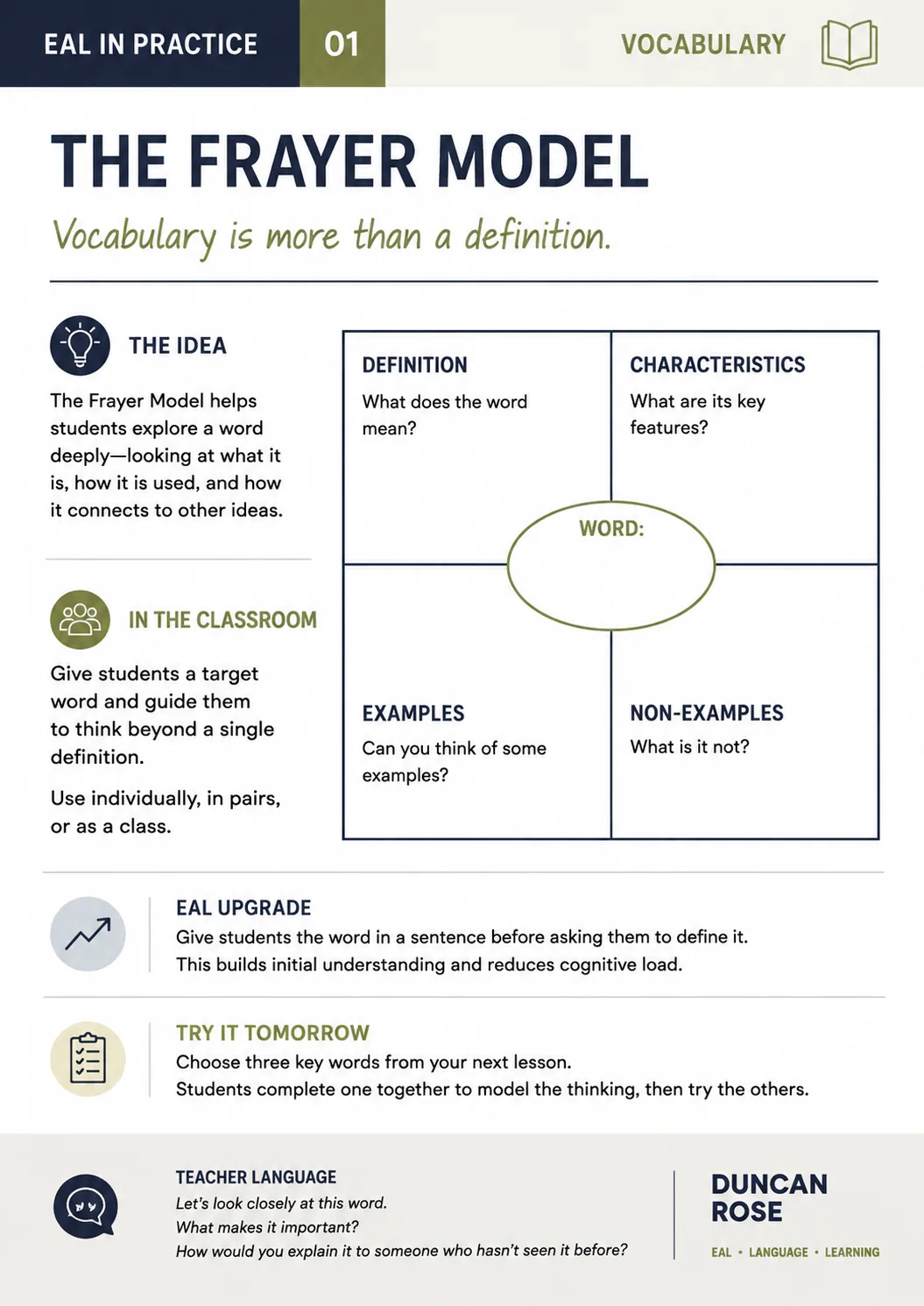
A change in form or state that does not produce a new substance.
Characteristics
The substance stays the same. Its shape or state may change.
Examples
Melting ice · cutting paper · crushing chalk
Non-examples
Burning paper · rusting iron
A model to discuss and adapt to your class.
Science: physical change
Meaning: the substance remains the same. Features: a change in shape or state; no new substance. Examples: ice melting, paper being cut. Non-examples: paper burning, iron rusting.
02 · The classroom routine
Teach the move
Prepare · 5 minutes
Choose one concept and two examples that reveal its boundaries. Prepare four spaces: meaning, features, examples and non-examples.
1
Start with an example: show ice melting and ask what changes and what stays the same.
2
Build a student-friendly meaning together: a physical change changes form or state without making a new substance.
3
Pairs sort melting ice, dissolving salt, burning paper and rusting iron. Ask them to explain a difficult choice.
4
Complete the four spaces, then test the meaning against a fresh case.
EAL upgrade
Remove the four-box organiser next time. Ask learners to explain the concept and reject a near miss in two sentences.
Keep the subject challenge. Offer one model, visual or language prompt where needed, then check a fresh independent response.
03 · A plan for the next lesson
Try it tomorrow
Choose three key words
Select three useful concepts from the next lesson. Show each word in a meaningful subject sentence.
Complete one together
Model a Frayer organiser for one concept. Ask learners to explain why each example belongs and each non-example does not.
Let learners try
Pairs complete the other concepts, using their existing knowledge and a home language where useful.
Check independently
Give each learner a new case: crushing a piece of chalk. Ask for a decision and a reason referring to the substance. A correct label without a reason is not enough.
What to look for
Give each learner a new case: crushing a piece of chalk. Ask for a decision and a reason referring to the substance. A correct label without a reason is not enough.
04 · Words you can use
Teacher language
Adapt these prompts to the task and your learners.
Launch
Let’s look closely at this word. What makes it important?
Probe the thinking
How would you explain this word to someone who has not seen it before?
Check independently
Which feature makes this an example? What rules the non-example out?
Hand over
Explain the concept in your own words, then test it with a new example.
05 · Keep the move, change the context
Across subjects
Transfer 1
Maths: compare rectangles with non-rectangular parallelograms; separate necessary features from typical appearances.
Transfer 2
Humanities: distinguish migration from tourism using duration and purpose, while discussing cases that need more information.
Adjust language support
Use a small word bank, visuals and partner rehearsal when needed. Extend with precise explanations and qualifications. Judge the support from the response to this task.
Keep the strategy. Change the subject.
Four classroom examples
Adapt the content to your curriculum. These responses model the language and thinking to look for.
Science
Set up the task
Sort melting ice, crushing chalk and rusting iron using a Frayer organiser for physical change.
Possible student response
A physical change does not form a new substance. Melting ice is an example; rusting iron is not.
Check the learning
Ask why cutting paper and burning paper belong in different boxes.