The resultant force is zero. This alone does not tell us whether the object is moving.
A model to discuss and adapt to your class.
Worked classroom example
Science: resultant, balanced, acceleration. Use a force diagram to link each term to the relationship between forces and motion.
02 · The classroom routine
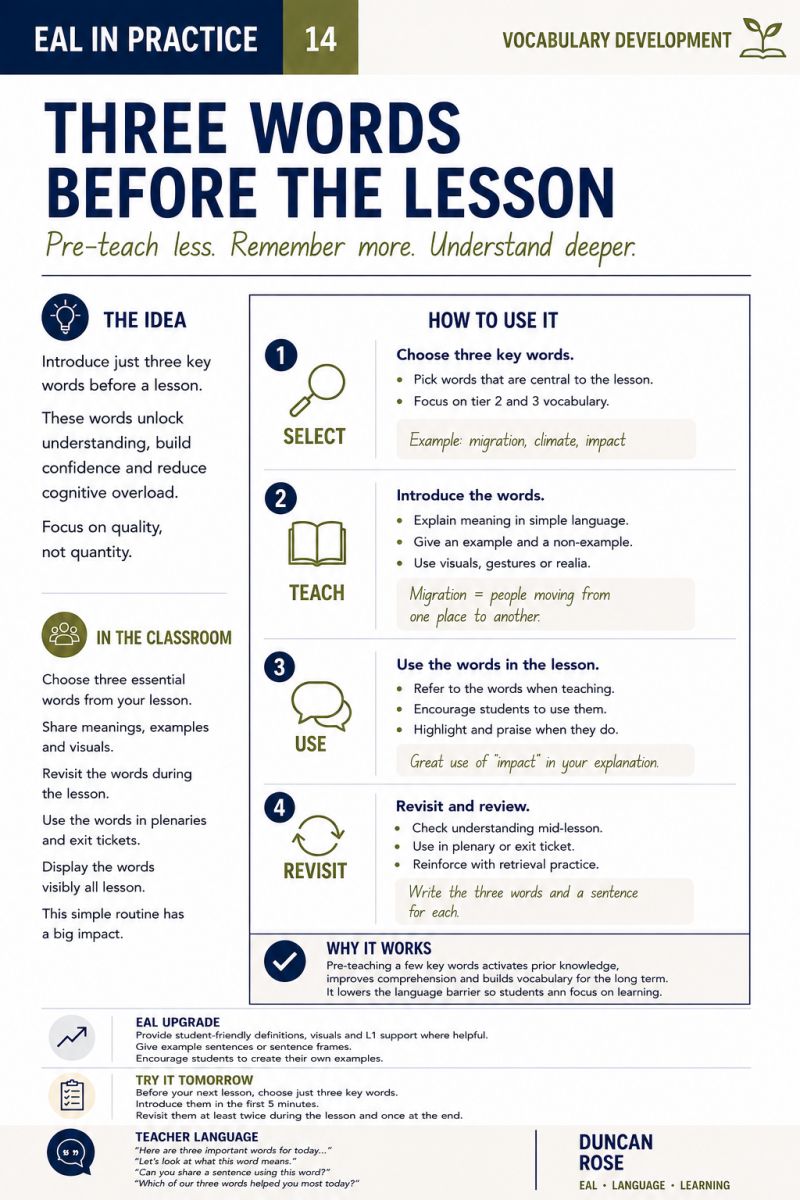
Teach the move
Prepare · 5 minutes
Select three terms essential to the next learning task, with a visual or example for each.
1
Show the three terms and connect each to a concrete example.
2
Ask learners to say, point to or sketch the meaning.
3
Use the terms in a short subject explanation.
4
Return to them in the task and again at the end.
EAL upgrade
Keep the terms visible initially, then ask for an explanation without the display.
Keep the subject challenge. Offer one model, visual or language prompt where needed, then check a fresh independent response.
03 · A plan for the next lesson
Try it tomorrow
Prepare one task
Select three terms essential to the next learning task, with a visual or example for each.
Model and rehearse
Show the three terms and connect each to a concrete example. Ask learners to say, point to or sketch the meaning.
Collect evidence
Change the diagram and ask learners to select the relevant term and explain it.
Next time
Keep the terms visible initially, then ask for an explanation without the display.
What to look for
Change the diagram and ask learners to select the relevant term and explain it.
04 · Words you can use
Teacher language
Adapt these prompts to the task and your learners.
Launch
Our purpose is: Teach a few essential terms that unlock the current task.
Probe the thinking
Which detail supports your explanation? Show me how you know.
Check independently
Try the new case on your own. Show the detail or reasoning that supports your answer.
Hand over
Which support do you still need, and which part can you now do independently?
05 · Keep the move, change the context
Across subjects
Transfer 1
Maths: gradient, intercept, coordinate before graph work.
Transfer 2
Humanities: cause, consequence, significance before analysing an event.
Adjust language support
Use a small word bank, visuals and partner rehearsal when needed. Extend with precise explanations and qualifications. Judge the support from the response to this task.
Keep the strategy. Change the subject.
Four classroom examples
Use the task, response and evidence check as a starting point for your curriculum.
Science
Set up the task
Preview resultant, direction and balanced before reading a force diagram.
Possible student response
Resultant is the combined effect; direction tells us where it acts; balanced means zero resultant.
Check the learning
Ask learners to use the words with a new diagram.
Humanities
Set up the task
Preview origin, purpose and limitation before analysing a source.
Possible student response
Origin identifies who, when and where; purpose considers intention; limitation qualifies what we can establish.
Check the learning
Check each term against the source rather than a memorised list.
English
Set up the task
Preview narrator, perspective and inference before discussing an extract.
Possible student response
The narrator tells the story from a perspective; our inference needs support from details.
Check the learning
Ask learners to distinguish what is stated from what is inferred.
Maths
Set up the task
Preview axis, interval and gradient before interpreting a graph.
Possible student response
The axes name quantities; the interval defines the section; gradient measures a rate of change.
Check the learning
Check that learners use the chosen interval and units.