How Mathematicians Explain Reasoning
Explain the relationship that makes a mathematical method appropriate, not simply the sequence of operations.
Worked model: How Mathematicians Explain Reasoning
View the illustrated activity card
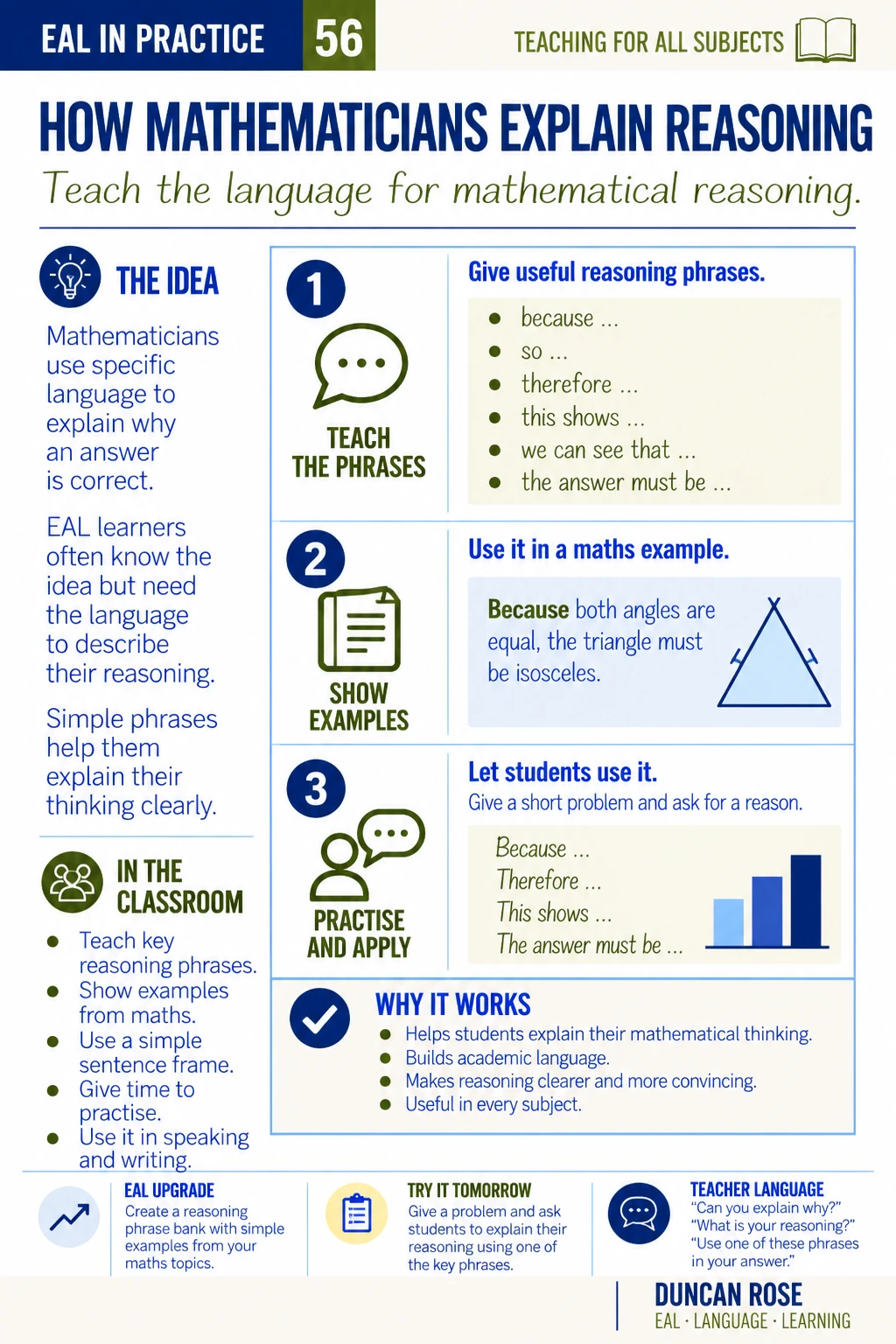

- 1Explain the relationship that makes a mathematical method appropriate, not simply the sequence of operations
- 2Read again to mark quantities, units and relationships
- 3Represent the relationship with a sketch, table or equation
- 4Choose a method and check the result against the original question
A recipe for four people uses 300 g of rice. For six people, identify the scale factor 6/4 before calculating 450 g. The story context does not change the proportional relationship.
Teach the move
Prepare · 5 minutes
Select a word problem with relevant and incidental information.
- 1
Explain the relationship that makes a mathematical method appropriate, not simply the sequence of operations.
- 2
Read again to mark quantities, units and relationships.
- 3
Represent the relationship with a sketch, table or equation.
- 4
Choose a method and check the result against the original question.
EAL upgrade
Remove supplied highlights and let learners choose their own representation.
Keep the subject challenge. Offer one model, visual or language prompt where needed, then check a fresh independent response.
Try it tomorrow
Select a word problem with relevant and incidental information.
Explain the relationship that makes a mathematical method appropriate, not simply the sequence of operations. Read again to mark quantities, units and relationships.
Give a new problem or flawed step and ask for the relevant relationship and justification before accepting the numerical result.
Remove supplied highlights and let learners choose their own representation.
What to look for
Give a new problem or flawed step and ask for the relevant relationship and justification before accepting the numerical result.
Teacher language
Adapt these prompts to the task and your learners.
Our purpose is: Explain the relationship that makes a mathematical method appropriate, not simply the sequence of operations.
Show the relationship and explain the choice you made.
Try the new case on your own. Show the detail or reasoning that supports your answer.
Which support do you still need, and which part can you now do independently?
Across subjects
Science: quantities and units in a practical question. Humanities: extract relevant evidence from a dense prompt.
Adjust language support
Use a small word bank, visuals and partner rehearsal when needed. Extend with precise explanations and qualifications. Judge the support from the response to this task.