Controlled translanguaging
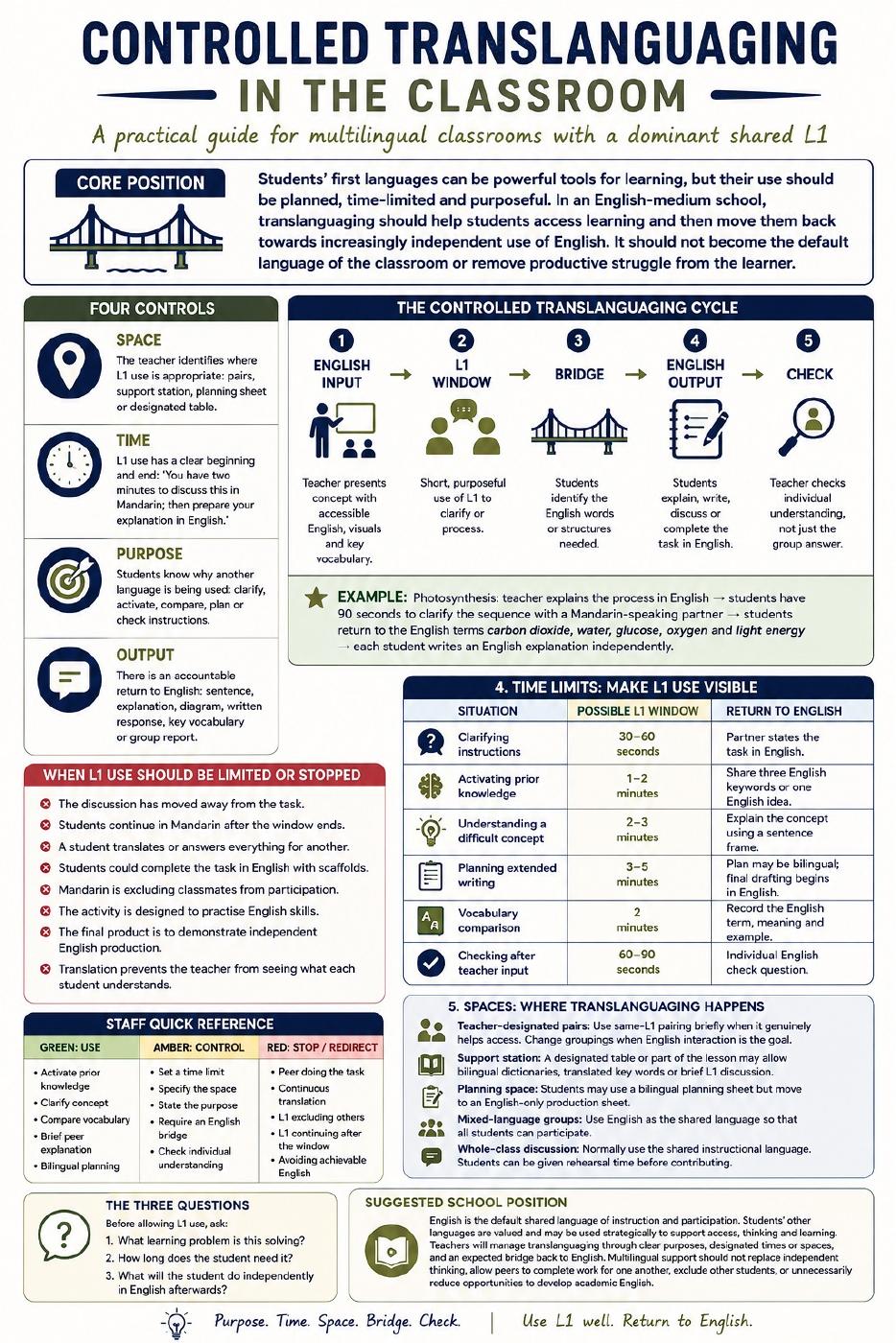
Use familiar languages to resolve a specific learning difficulty, then help learners communicate increasingly independently in English when that is the intended task outcome. This approach is particularly relevant in English-medium classrooms with a dominant shared home language.
Plan the language choice
- Purpose: identify the concept, vocabulary or instruction learners need to clarify.
- Space: decide whether the support is in a pair, a station or a planning sheet. Keep other classmates able to participate.
- Time: agree a visible, proportionate window. A short vocabulary clarification and a complex planning task may need different times.
- Bridge: specify the English terminology, rehearsal or explanation learners will produce next.
- Check: ask each learner to explain or apply the idea independently.
A classroom cycle
Give accessible English input with a diagram or model. Allow a purposeful clarification window where needed. Ask learners to identify the English terms and relationships they need, rehearse the response, then complete an individual check. Adjust the next scaffold from that evidence.
Worked science example
The teacher models photosynthesis using a labelled diagram. Pairs have a brief familiar-language window to clarify the process, then identify the English terms light, carbon dioxide, water, chlorophyll, glucose and oxygen. Each learner independently explains one connection using the diagram and an appropriate causal phrase. A peer can clarify meaning but does not supply the final answer.
Teacher language to adapt
- “Use a language you know to clarify this idea with your partner. Then identify the English terms you need.”
- “The planning window ends now. Rehearse your own English explanation using the diagram.”
- “Your partner may explain the concept. Each of you will answer the next question independently.”
- “This phase practises English discussion. Use the vocabulary support and ask for a prompt if you need one.”
Review the purpose, participation and ownership
Redirect the activity when talk moves away from the task, excludes classmates or lets one learner produce everyone’s response. Start by restating the purpose and offering a suitable English scaffold. Rotate explanation roles and sample each learner’s understanding. Keep language support connected to the learning goal rather than treating a learner’s home language as a problem.
Staff reference and downloads
The resources below are the supplied controlled translanguaging guides. They are context-specific planning resources; adapt the timing, grouping and English outcome to the learners and task.
Download illustrated guide Download staff guide
View the illustrated staff reference
Plan one action
Choose a manageable action, give it an owner and decide how you will hear from learners before reviewing it.