Condensation · energy transferred from the substance
A model to discuss and adapt to your class.
Worked classroom example
Science: sort melting, freezing, evaporation and condensation by direction of state change; then regroup by whether energy is transferred to or from the substance.
02 · The classroom routine
Teach the move
Prepare · 5 minutes
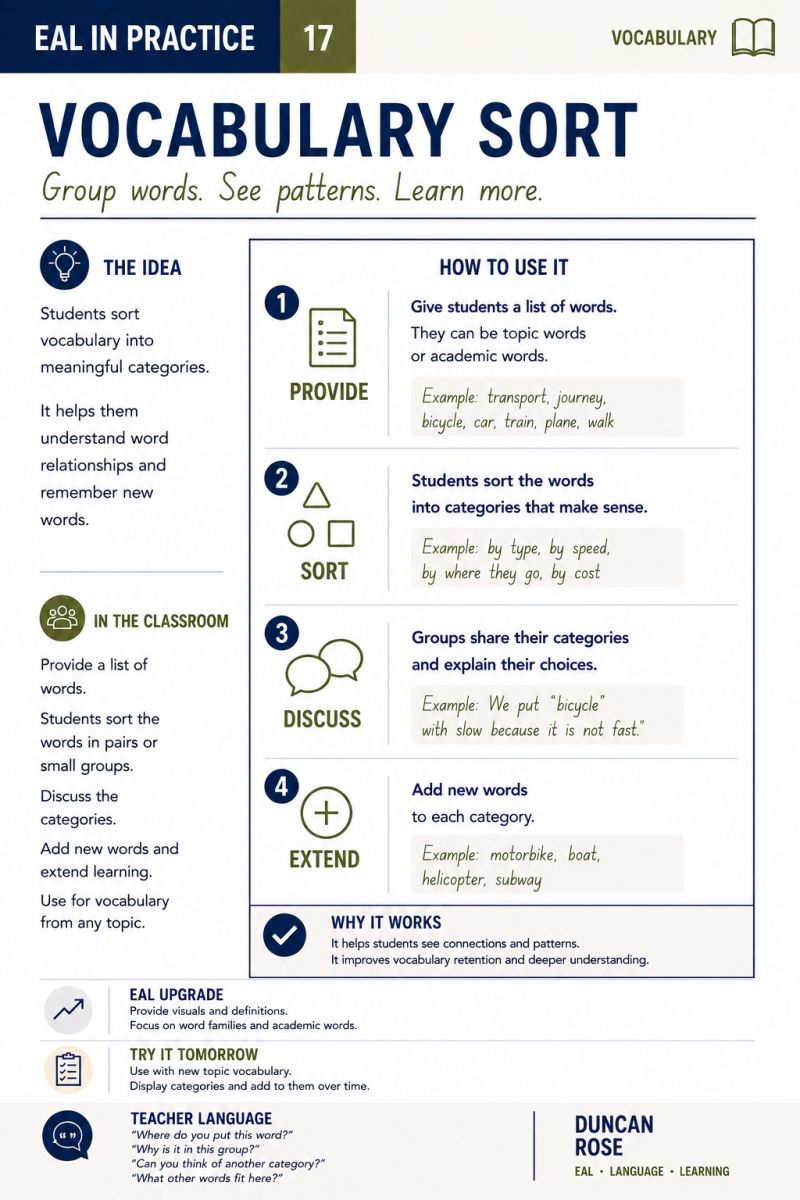
Choose a small set of terms and a sorting rule connected to the subject concept.
1
Introduce the sorting criterion with one example.
2
Pairs sort the words and mark uncertain choices.
3
Discuss a borderline item using evidence or a definition.
4
Change the criterion and explain why the grouping changes.
EAL upgrade
Remove category labels and ask learners to propose a useful classification.
Keep the subject challenge. Offer one model, visual or language prompt where needed, then check a fresh independent response.
03 · A plan for the next lesson
Try it tomorrow
Prepare one task
Choose a small set of terms and a sorting rule connected to the subject concept.
Model and rehearse
Introduce the sorting criterion with one example. Pairs sort the words and mark uncertain choices.
Collect evidence
Use a new term or diagram and ask for the criterion, not just the pile.
Next time
Remove category labels and ask learners to propose a useful classification.
What to look for
Use a new term or diagram and ask for the criterion, not just the pile.
04 · Words you can use
Teacher language
Adapt these prompts to the task and your learners.
Launch
Our purpose is: Organise vocabulary by meaningful subject relationships.
Probe the thinking
Which detail supports your explanation? Show me how you know.
Check independently
Try the new case on your own. Show the detail or reasoning that supports your answer.
Hand over
Which support do you still need, and which part can you now do independently?
05 · Keep the move, change the context
Across subjects
Transfer 1
Maths: sort quadrilaterals by properties, allowing overlapping categories.
Transfer 2
Humanities: sort causes into short-term and long-term, discussing disputed cases.
Adjust language support
Use a small word bank, visuals and partner rehearsal when needed. Extend with precise explanations and qualifications. Judge the support from the response to this task.
Keep the strategy. Change the subject.
Four classroom examples
Use the task, response and evidence check as a starting point for your curriculum.
Science
Set up the task
Sort melting, freezing, evaporation and condensation by their starting and ending states.
Possible student response
Melting is solid to liquid; condensation is gas to liquid.
Check the learning
Invite a second sort by energy transferred to or from the substance.
Humanities
Set up the task
Sort statements into observation, interpretation and unsupported claim.
Possible student response
“The poster addresses young men” is an observation; “everyone agreed” is an unsupported claim.
Check the learning
Ask learners to justify any disputed placements with evidence.
English
Set up the task
Sort whispered, roared, murmured and shouted using a named criterion.
Possible student response
Whispered and murmured describe quieter speech; shouted and roared suggest louder speech.
Check the learning
Discuss how context can affect a word’s force rather than insisting on one fixed ranking.
Maths
Set up the task
Sort y = 2x, y = 3x, y = 2x + 1 and y = x² into categories.
Possible student response
The first two are directly proportional; y = 2x + 1 is linear but not directly proportional.
Check the learning
Ask where y = x² belongs and why it does not fit either linear group.