365 teaching moves, ready to use.
Clear sequences, worked examples and checks for understanding across the curriculum.
 Vocabulary · 5 min prep
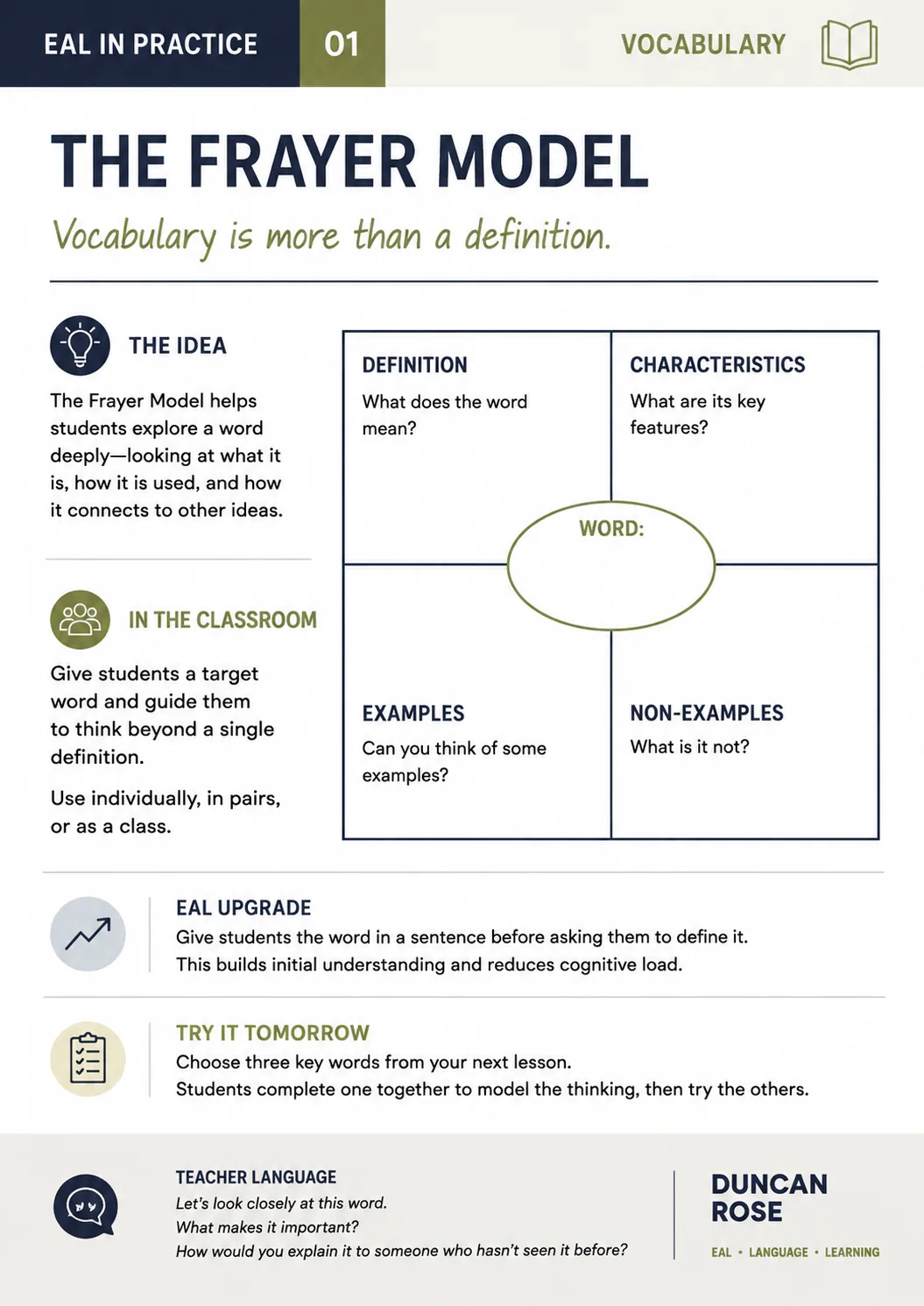
The Frayer Model
Help learners distinguish a concept from its near misses, rather than memorising a definition.
Open lesson → Speaking · 2 min prep
The 30-Second Rehearsal
Give every learner a brief chance to organise an explanation before addressing the class.
Open lesson → Vocabulary · 5 min prep
Odd One Out
Compare properties and defend a classification with evidence.
Open lesson → Reading · 5 min prep
Before You Hand Out the Worksheet
Remove avoidable language barriers before a worksheet begins.
Open lesson →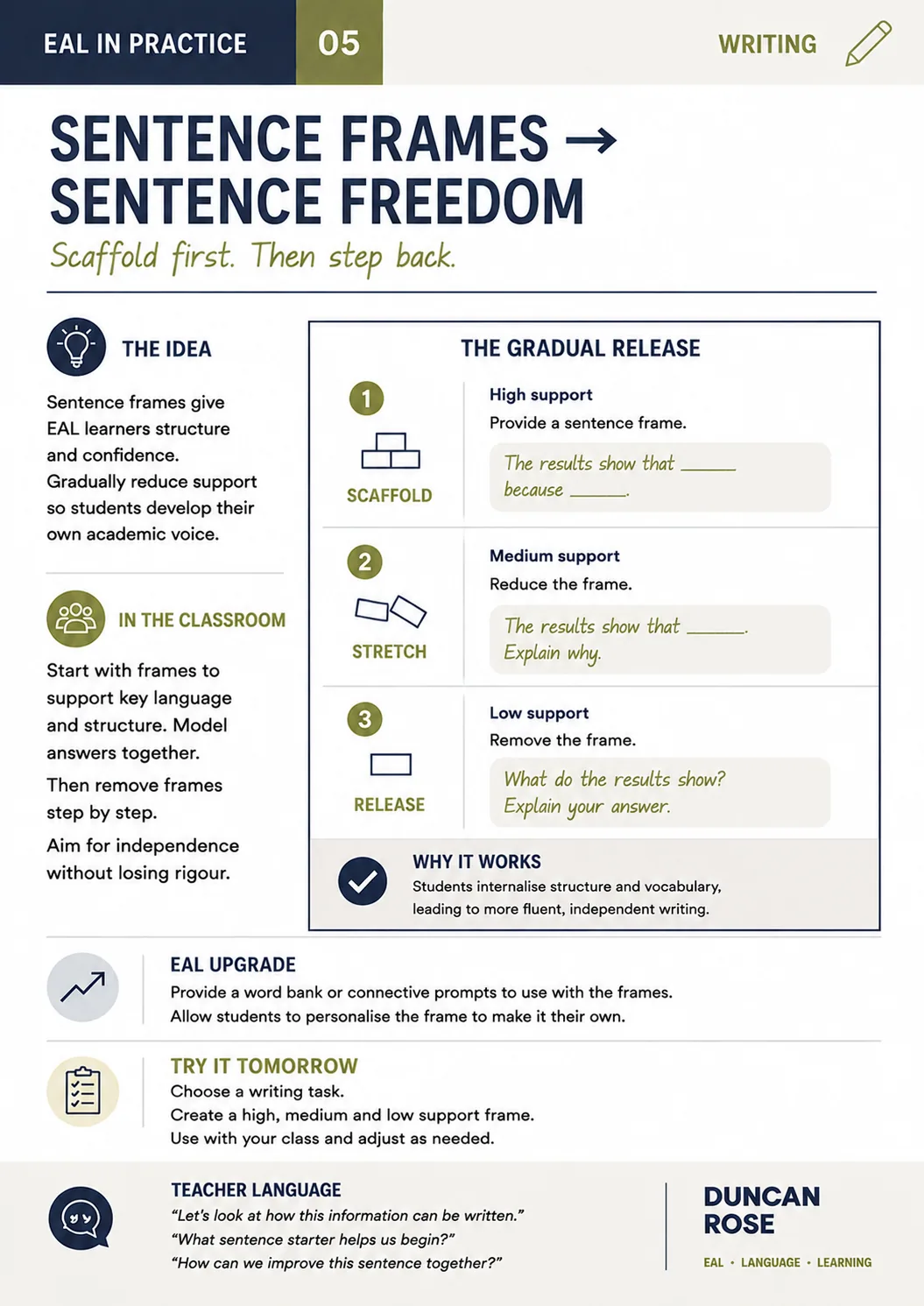 Writing · 5 min prep
Sentence Frames → Sentence Freedom
Support the language of an explanation while deliberately moving towards independent wording.
Open lesson → Vocabulary · 5 min prep
Vocabulary Continuum
Choose vocabulary that expresses the intended degree or relationship.
Open lesson → Speaking · 3 min prep
Think → Pair → Improve → Share
Make discussion improve an idea, rather than simply repeat two first answers.
Open lesson →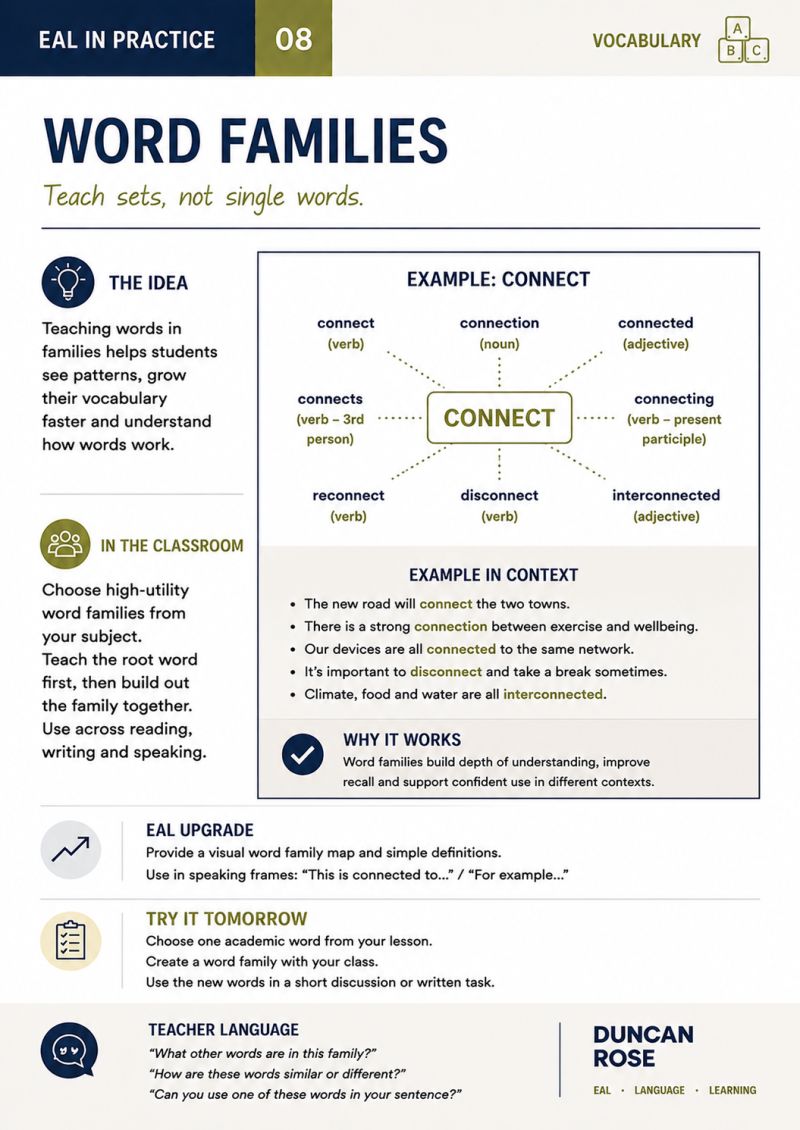 Vocabulary · 5 min prep
Word Families
Use related word forms accurately in subject sentences.
Open lesson → Assessment · 3 min prep
Stop Asking “Do You Understand?”
Replace a yes/no comprehension question with evidence of what each learner can actually do.
Open lesson → Speaking · 5 min prep
Vocabulary Taboo
Explain a concept precisely enough for someone else to identify it.
Open lesson → Writing · 3 min prep
Because → But → So
Show how a connective changes the relationship between ideas and the thinking a sentence must express.
Open lesson →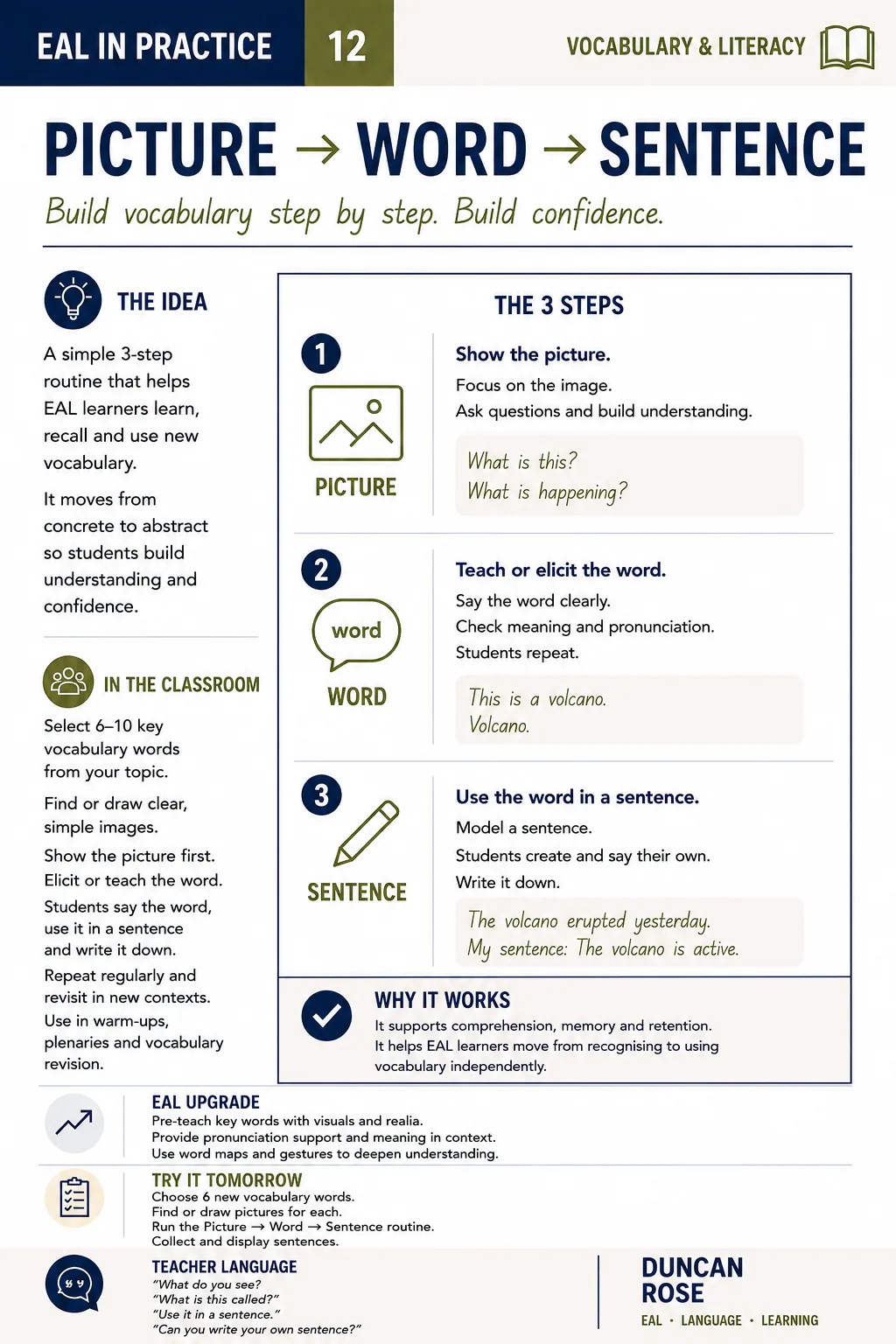 Writing · 3 min prep
Picture → Word → Sentence
Help learners turn a visible observation into a precise subject sentence.
Open lesson → Speaking · 5 min prep
Information Gap
Create a real reason to ask, listen and clarify: each partner has information the other needs.
Open lesson →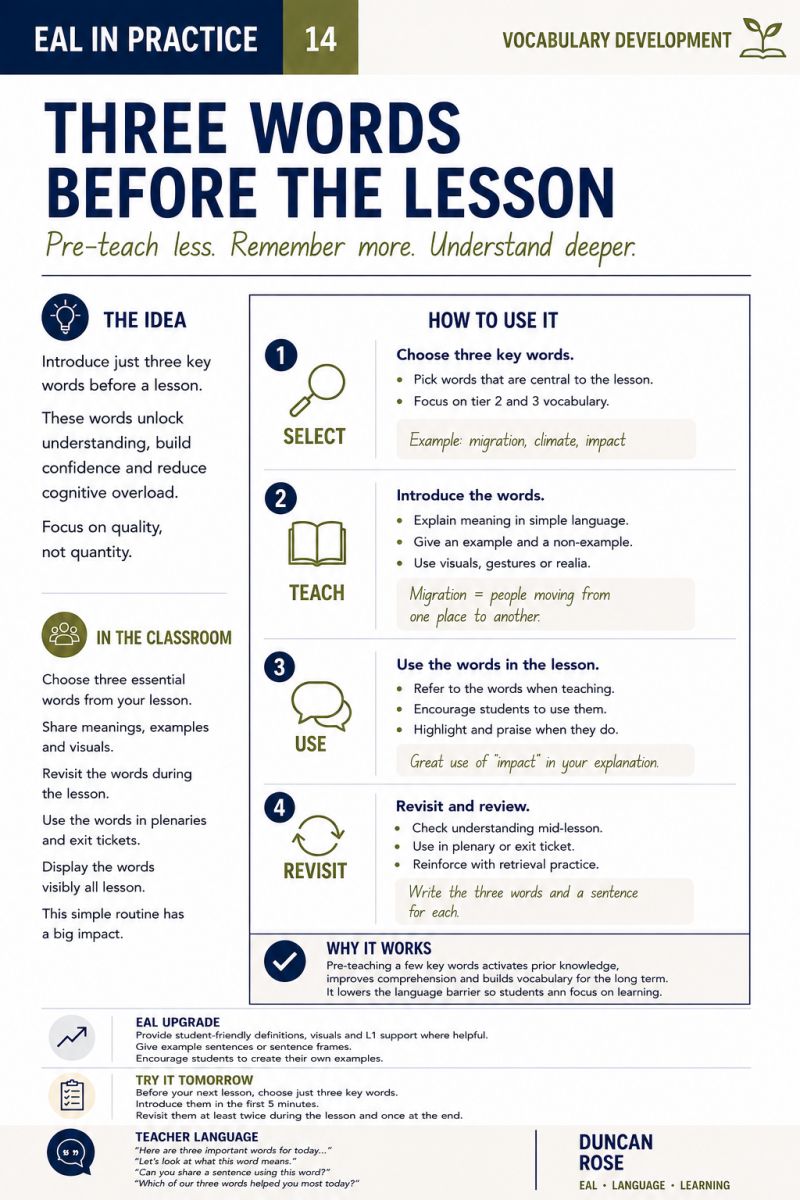 Vocabulary · 5 min prep
Three Words Before the Lesson
Teach a few essential terms that unlock the current task.
Open lesson → Listening · 5 min prep
Running Dictation
Listen, communicate and reconstruct accurate subject meaning.
Open lesson → Speaking · 5 min prep
Say It Better
Improve one vague response through a precise language choice.
Open lesson →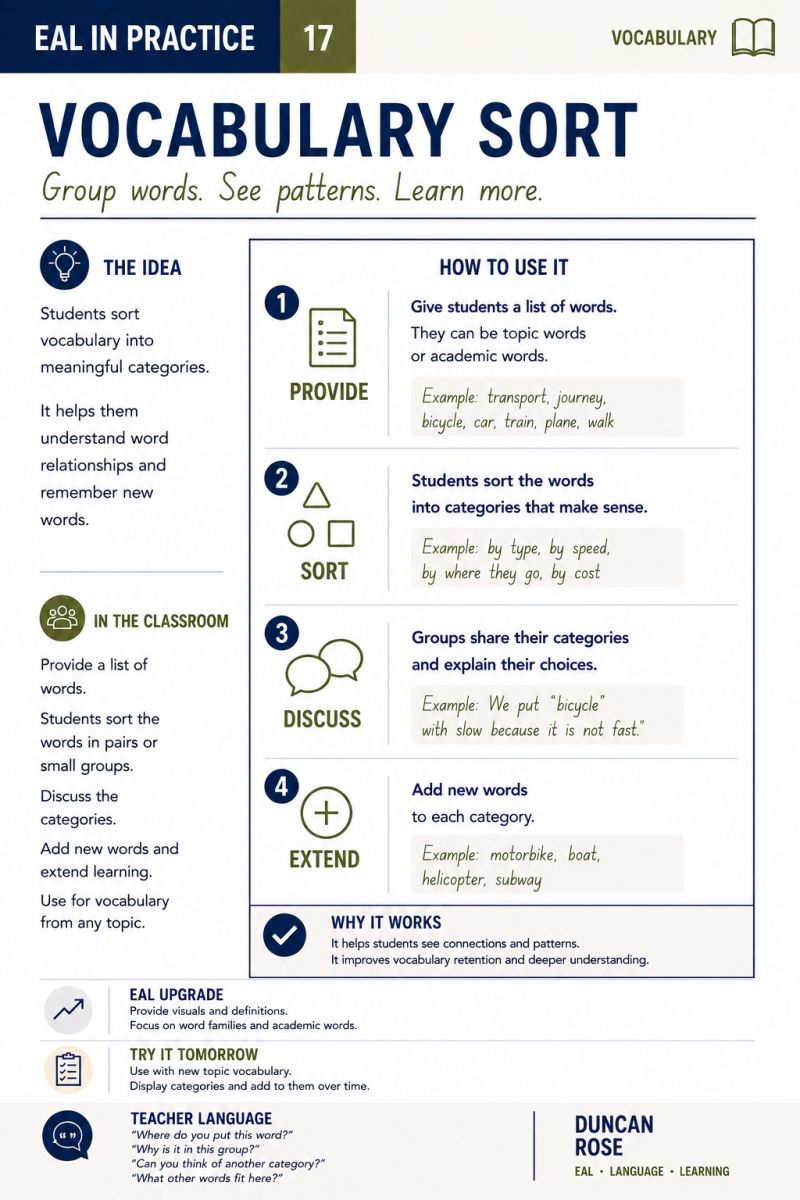 Vocabulary · 5 min prep
Vocabulary Sort
Organise vocabulary by meaningful subject relationships.
Open lesson → Reading · 5 min prep
Cut the Instructions
Make a sequence of actions clear without losing essential conditions.
Open lesson → Listening · 5 min prep
Dictogloss
Reconstruct meaning and notice how language expresses it.
Open lesson → Speaking · 5 min prep
One Word Is Not an Answer
Extend a key word into an explanation that shows understanding.
Open lesson → Writing · 5 min prep
Give Them the First Sentence
Give learners a route into writing while leaving the reasoning to them.
Open lesson → Writing · 5 min prep
Stop Correcting Everything
Focus feedback on one useful language improvement at a time.
Open lesson →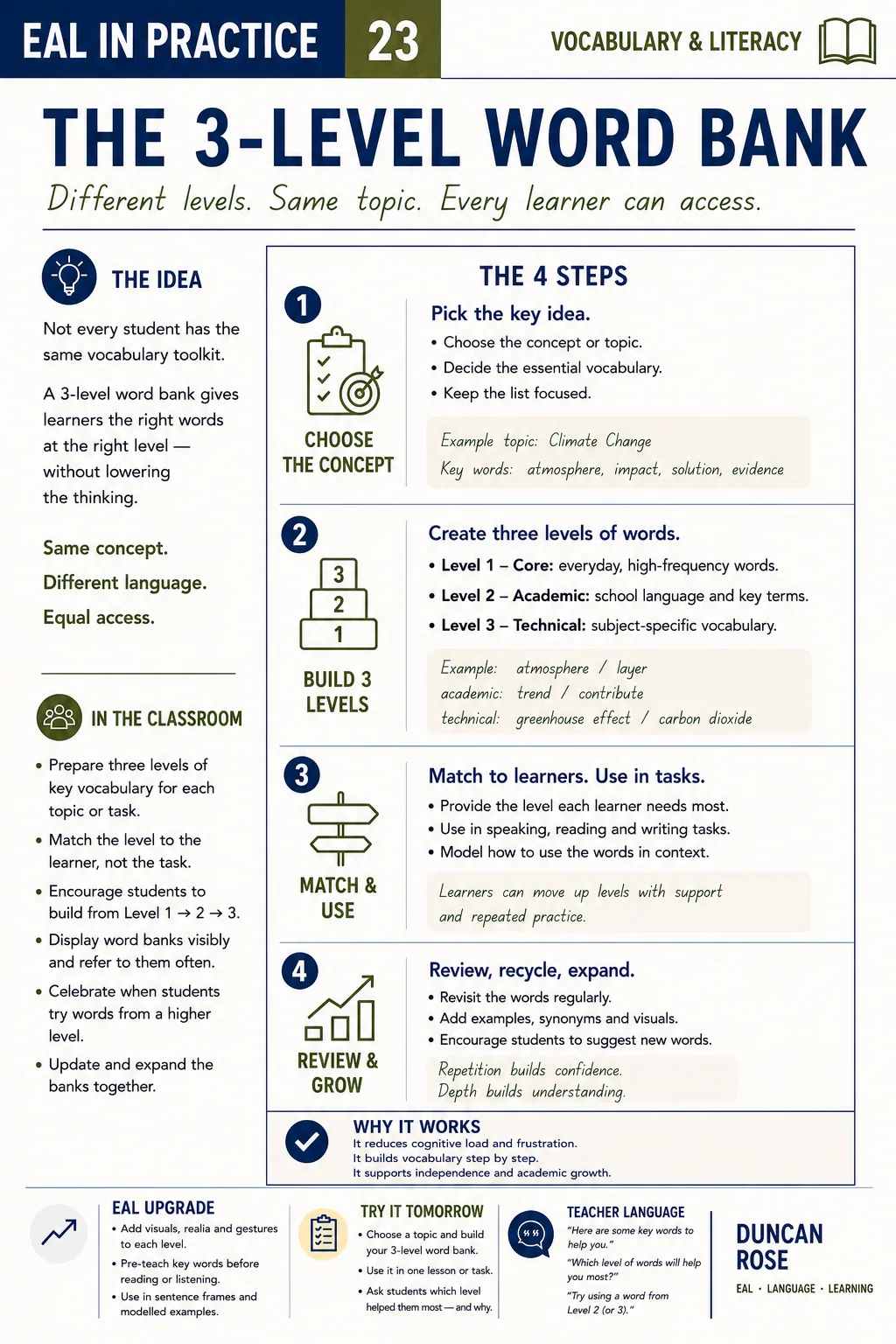 Vocabulary · 5 min prep
The 3-Level Word Bank
Combine everyday, academic and technical language purposefully.
Open lesson → Assessment · 5 min prep
Make the Question Smaller
Build towards a demanding question through manageable entry points.
Open lesson → Reading · 5 min prep
The Model Answer Autopsy
Help learners see how an answer earns its meaning and quality, then transfer those moves to a fresh response.
Open lesson → Vocabulary · 5 min prep
Stop Giving Bigger Word Lists
Prioritise useful vocabulary and meaningful reuse over list length.
Open lesson → Writing · 5 min prep
One Diagram, Three Sentences
Move from visible features to relationships and explanation.
Open lesson → Listening · 3 min prep
Give Them Something to Listen For
Make listening purposeful with one clear target before learners hear an explanation.
Open lesson → Vocabulary · 5 min prep
The Vocabulary Recycling Rule
Reuse vocabulary in fresh contexts after a gap.
Open lesson → Reading · 5 min prep
Don't Simplify the Science
Preserve the scientific challenge while improving language access.
Open lesson → Reading · 5 min prep
Before You Show the Text
Give learners a reason and a route into reading.
Open lesson → Speaking · 5 min prep
Who Is Doing the Talking?
Make space for every learner to explain and reason.
Open lesson → Reading · 5 min prep
Pictures Aren’t Just for Beginners
Use visuals to interpret complex relationships.
Open lesson → Assessment · 5 min prep
The 60-Second Retrieval Routine
Retrieve an important idea and respond to the evidence.
Open lesson → Listening · 5 min prep
The Instruction Check
Check what learners will do before the task begins.
Open lesson → Reading · 5 min prep
Highlight the Language Load
Identify the language a demanding task requires.
Open lesson → Writing · 5 min prep
Don't Ask Them to Write Cold
Prepare ideas and reasoning before independent writing.
Open lesson → Speaking · 5 min prep
Give Them Processing Time
Give learners a purposeful route through processing time.
Open lesson → Assessment · 5 min prep
The Scaffold Test
Check whether a scaffold enables independent performance.
Open lesson → Writing · 5 min prep
Every Subject Has a Language
Make disciplinary thinking visible through its language.
Open lesson → Writing · 5 min prep
What Language Does This Task Need?
Plan language support from the intended task outcome.
Open lesson → Writing · 5 min prep
The Hidden Language of Science
Express scientific processes, mechanisms and evidence precisely.
Open lesson → Writing · 5 min prep
The Hidden Language of Maths
Clarify the language of mathematical reasoning and interpretation.
Open lesson → Writing · 5 min prep
The Hidden Language of Humanities
Support interpretations with evidence and acknowledge limits.
Open lesson → Speaking · 5 min prep
The Hidden Language of Practical Work
Build language into safe, thoughtful practical work.
Open lesson → Writing · 5 min prep
Stop Saying “Use Academic Language”
Replace “use academic language” with a named language choice needed for the task: precise vocabulary, an evidence link or a qualification.
Open lesson →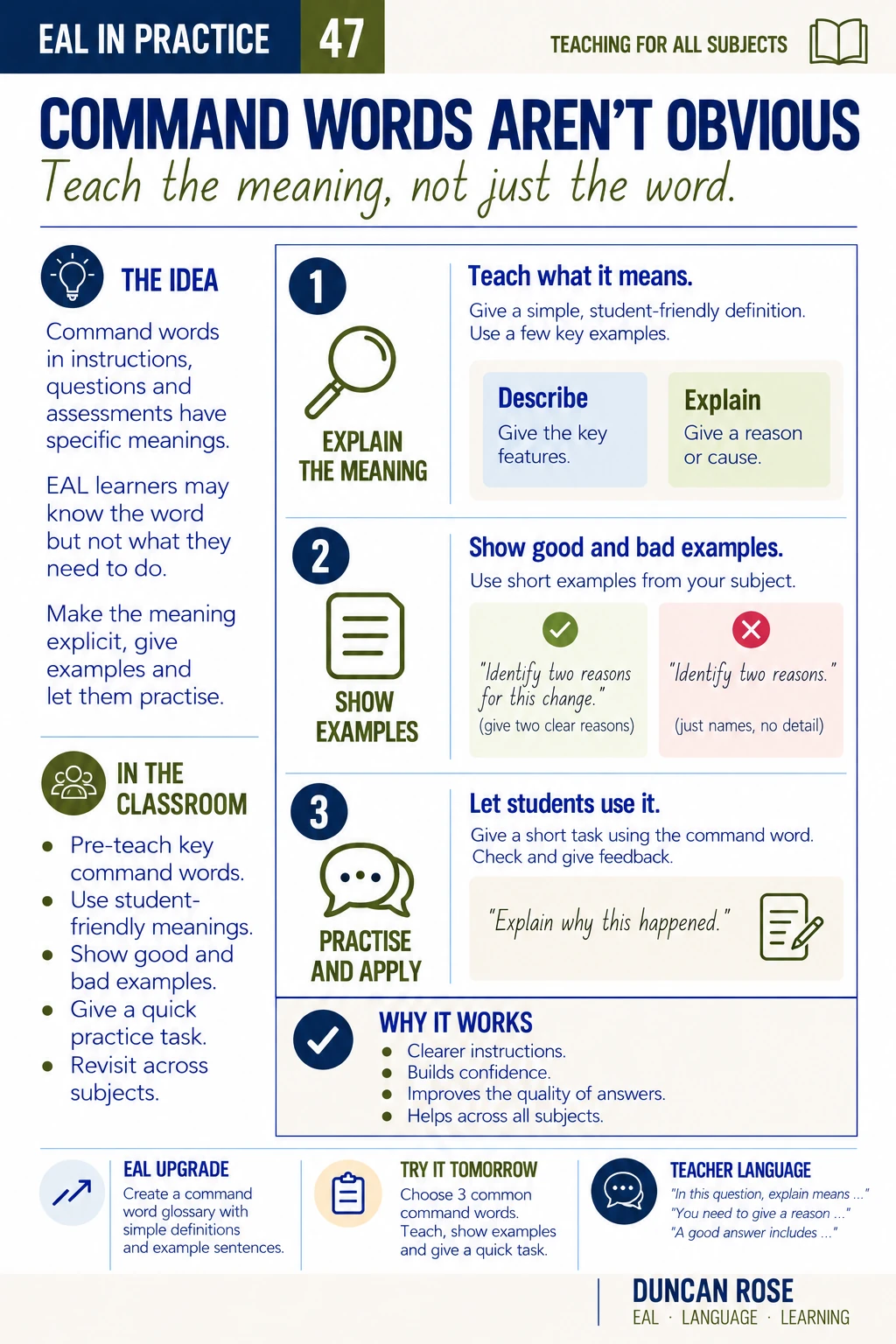 Reading · 5 min prep
Command Words Aren't Obvious
Contrast two command words applied to the same source or diagram and show how the required answer changes.
Open lesson →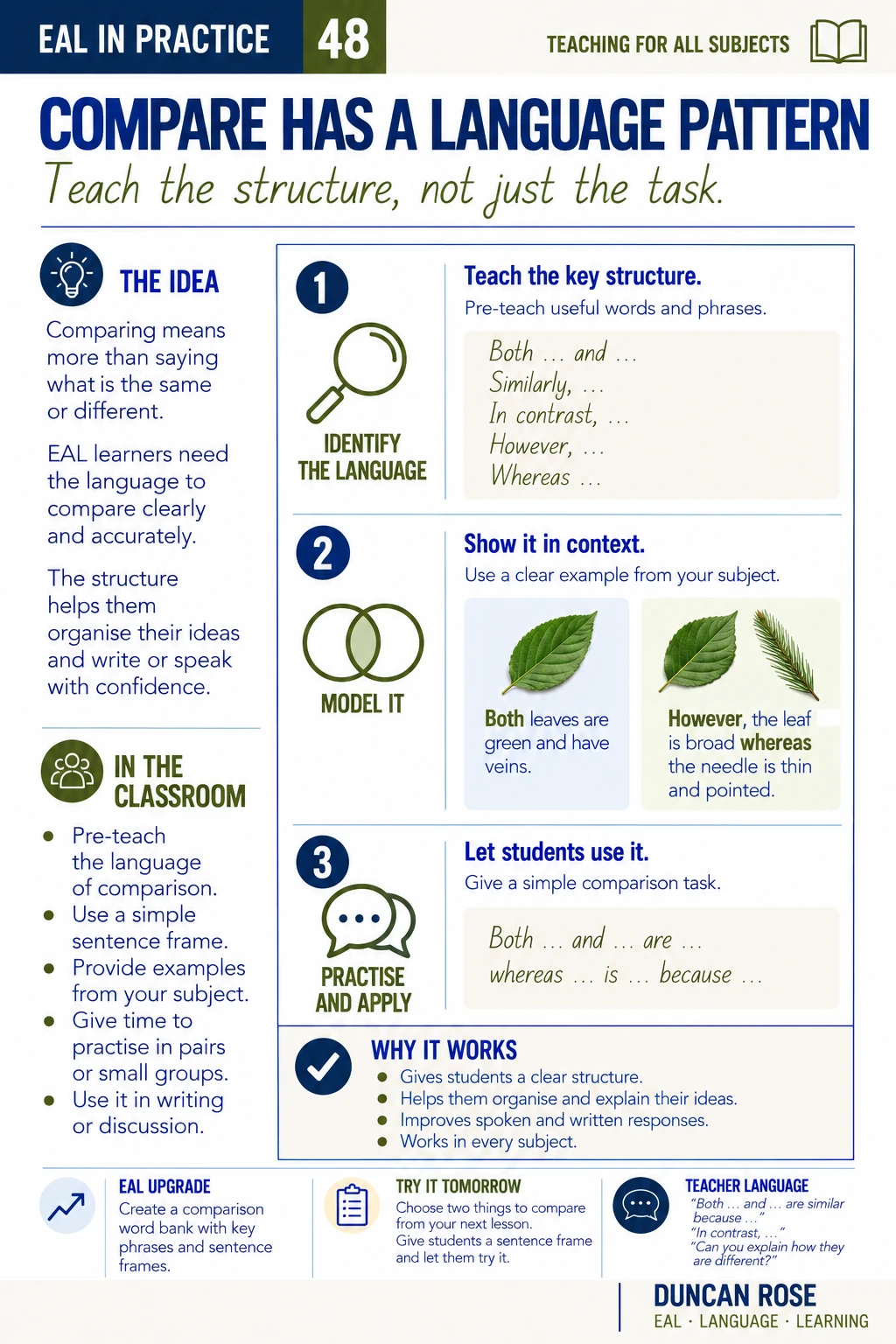 Writing · 5 min prep
Compare Has a Language Pattern
Compare two cases using one shared criterion; write a similarity and a contrast supported by both cases.
Open lesson → Writing · 5 min prep
Explain Means Cause and Effect
Explain a result by naming the mechanism that connects its cause and consequence.
Open lesson →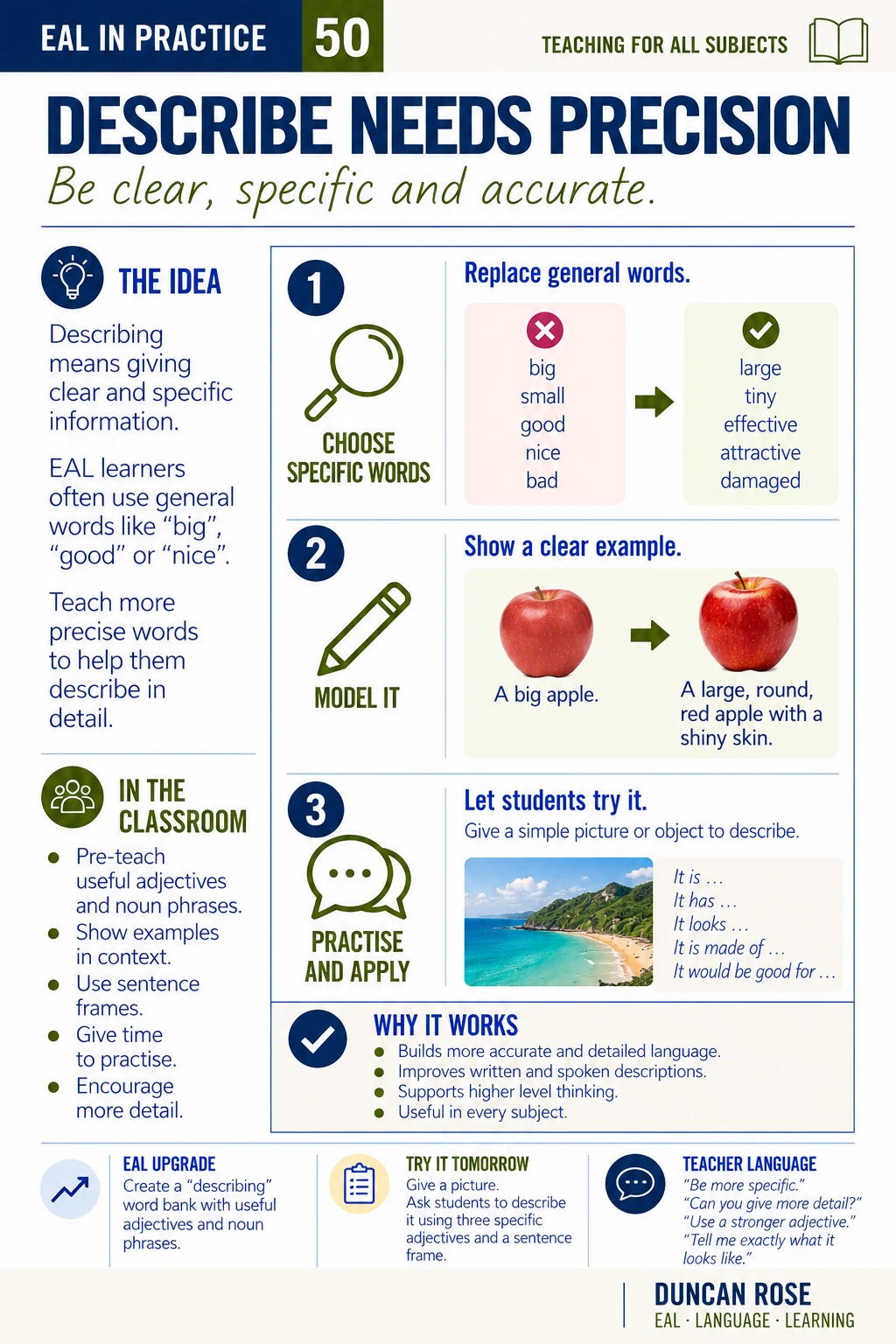 Writing · 5 min prep
Describe Needs Precision
Describe a visible change using exact features, direction, quantity and units before offering a cause.
Open lesson → Writing · 5 min prep
Evidence Needs Language
Give a claim an evidence sentence that names the relevant value or source detail and explains its relevance.
Open lesson →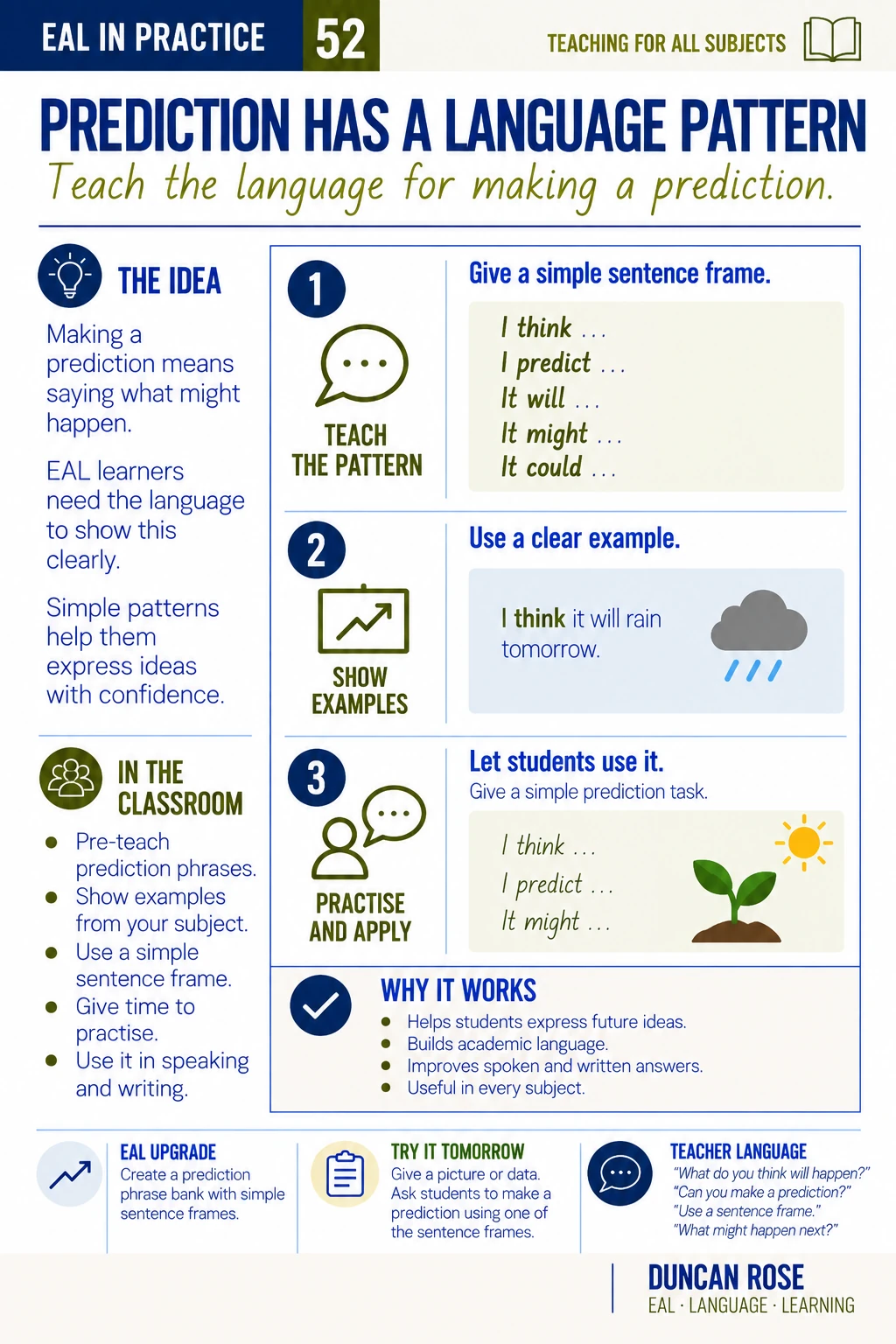 Writing · 5 min prep
Prediction Has a Language Pattern
State an expected outcome from a pattern and name the conditions under which it is expected.
Open lesson → Writing · 5 min prep
Hypothesise Before You Experiment
Write a relationship between measurable variables that an investigation could support or challenge.
Open lesson → Writing · 5 min prep
How Scientists Hedge
Use scientific hedging to name the limits of a result, rather than adding vague uncertainty everywhere.
Open lesson → Reading · 5 min prep
How Historians Qualify Claims
Qualify a historical claim by naming what the source's purpose and perspective allow it to establish.
Open lesson →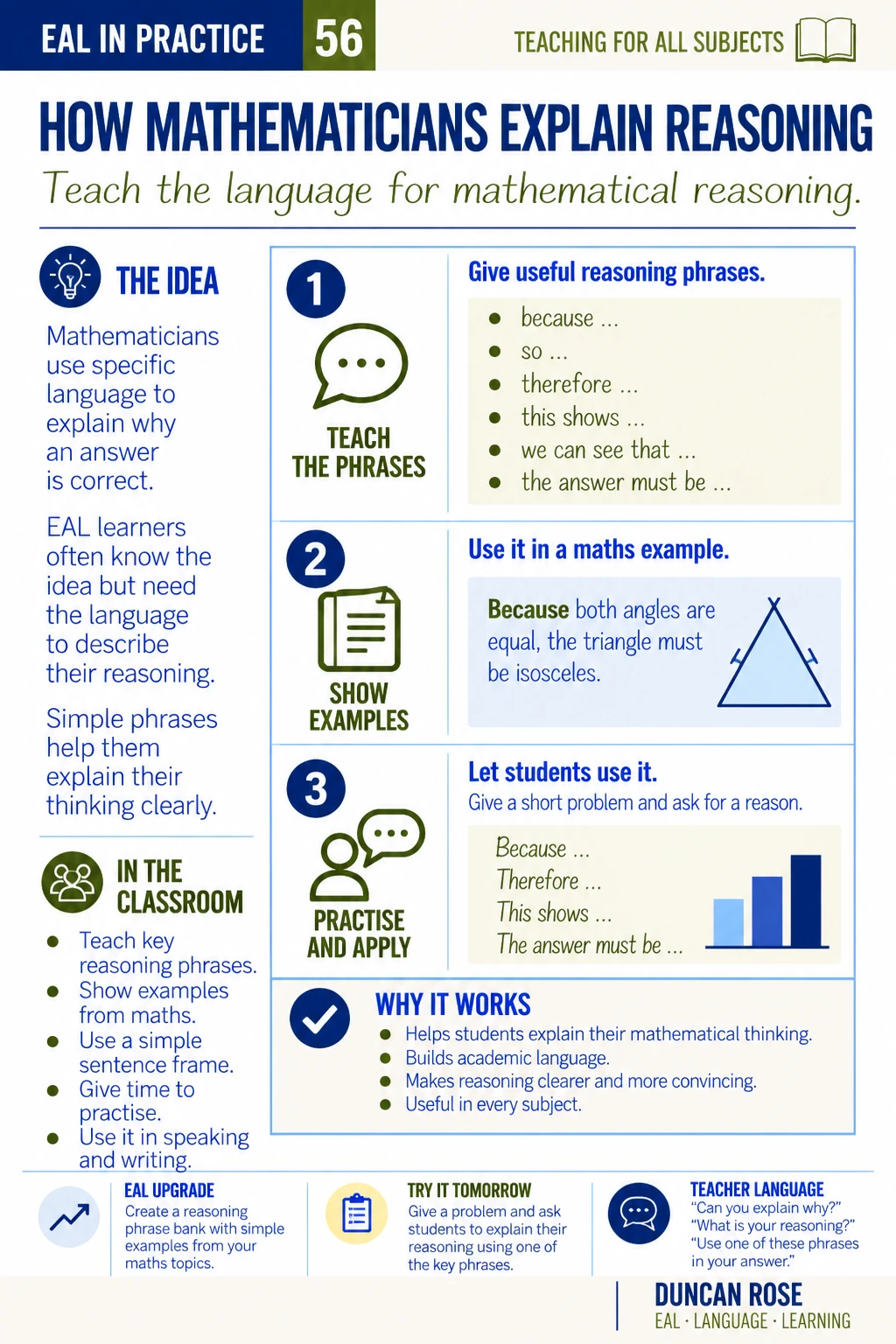 Reading · 5 min prep
How Mathematicians Explain Reasoning
Explain the relationship that makes a mathematical method appropriate, not simply the sequence of operations.
Open lesson → Writing · 5 min prep
Claim → Evidence → Reasoning
Build a response with a claim, a precise evidence item and the reasoning that connects them.
Open lesson →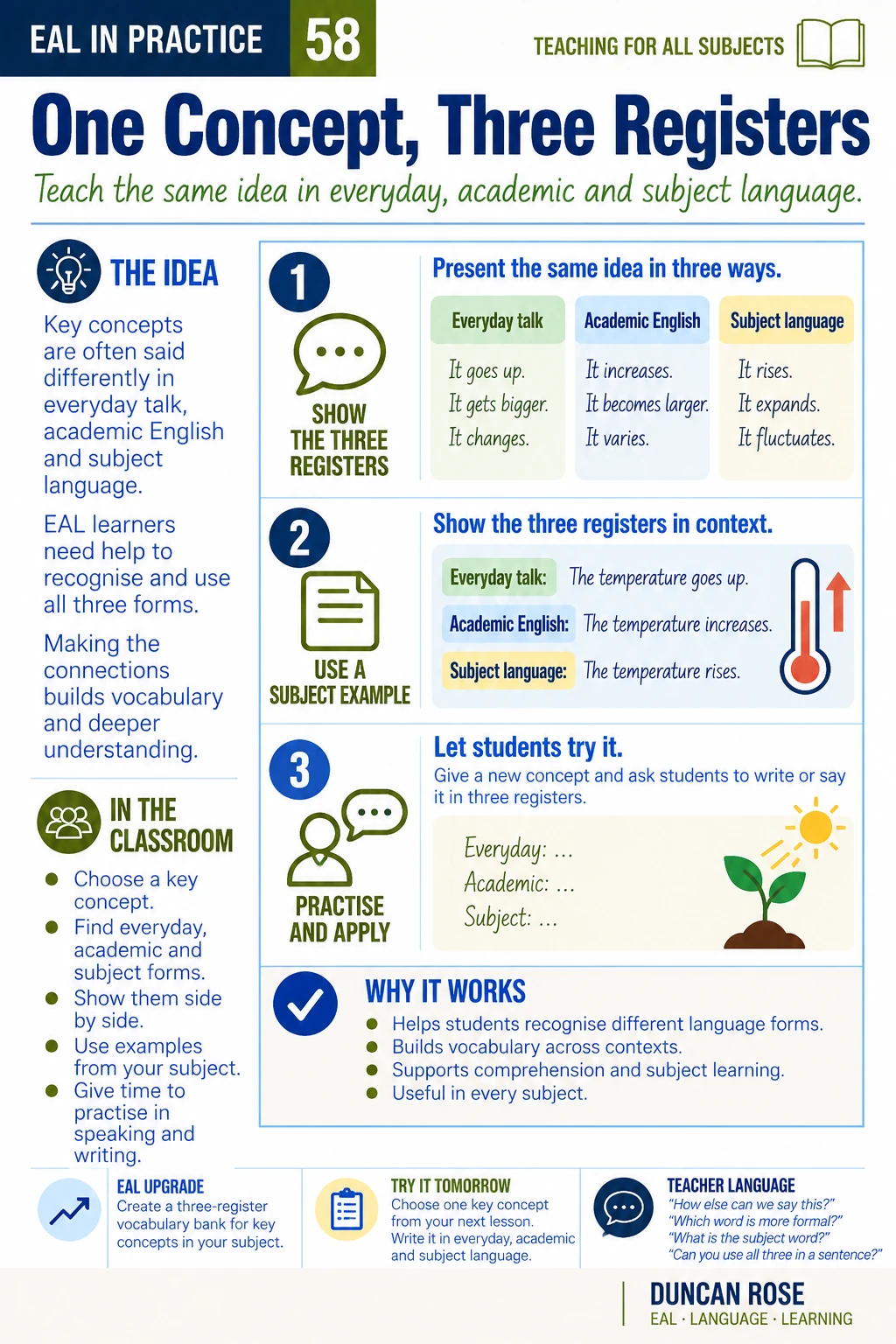 Writing · 5 min prep
One Concept, Three Registers
Express the same concept in everyday, classroom and formal subject wording and check that its meaning stays intact.
Open lesson →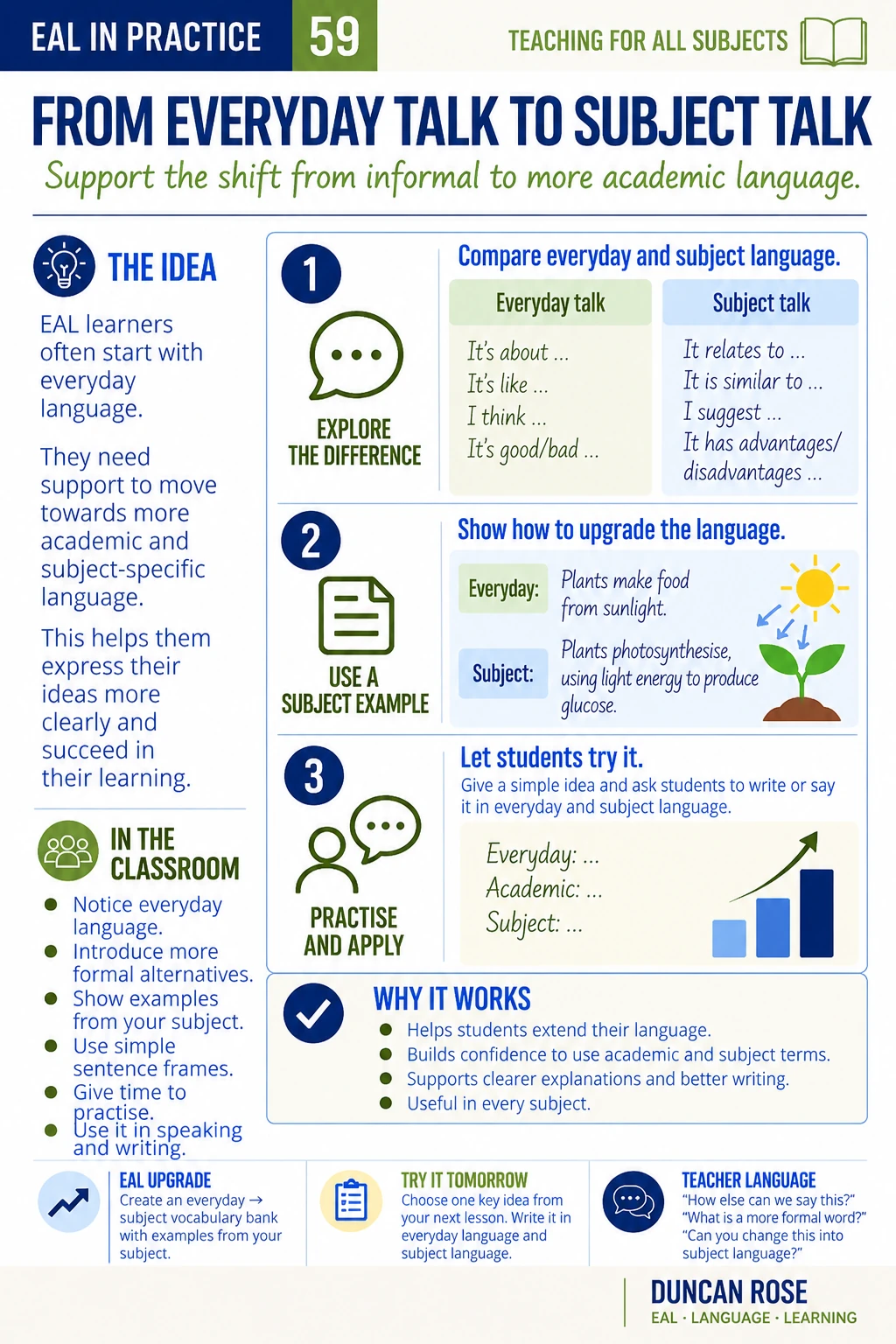 Writing · 5 min prep
From Everyday Talk to Subject Talk
Reformulate an everyday response by adding the technical term and relationship the subject explanation needs.
Open lesson →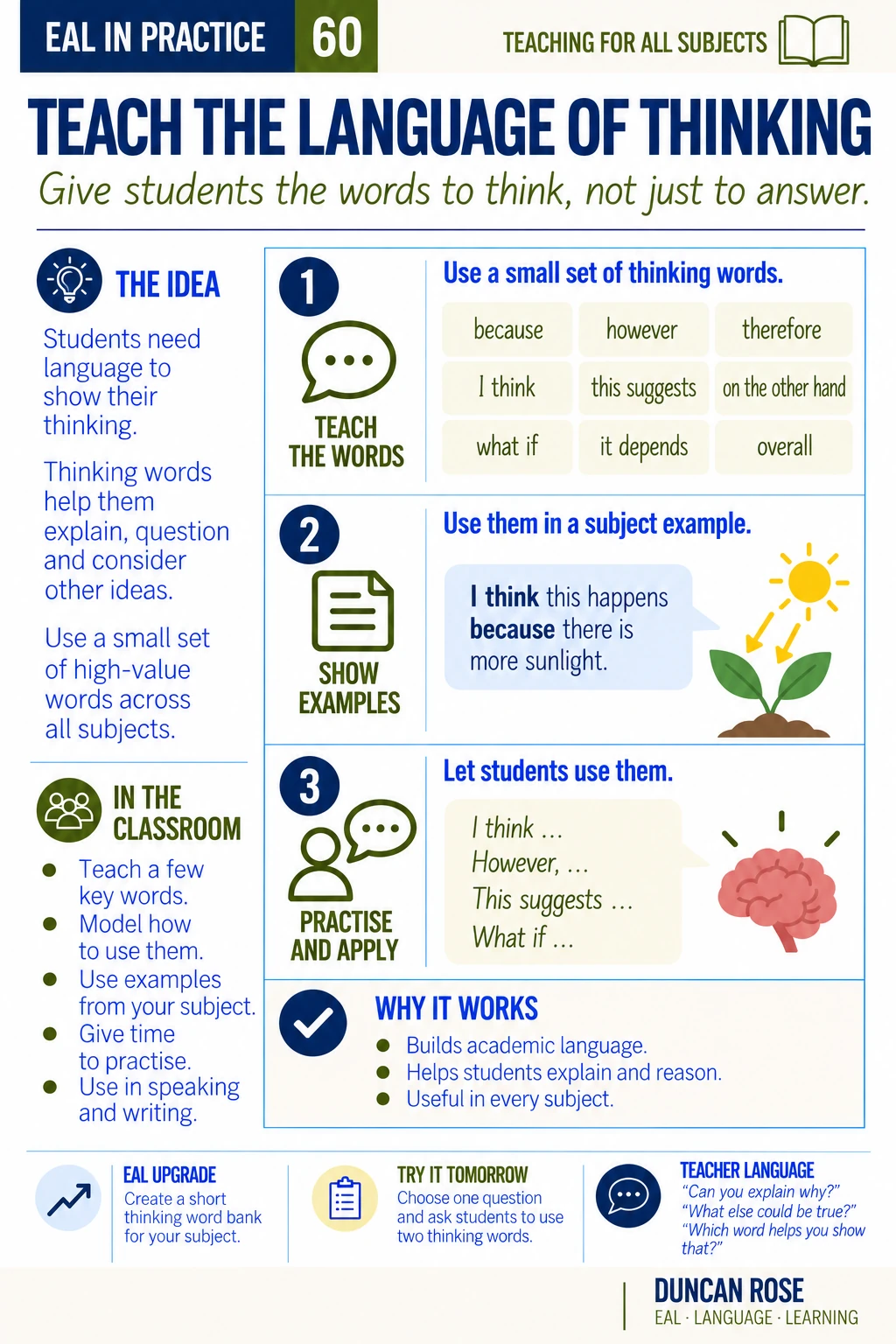 Reading · 5 min prep
Teach the Language of Thinking
Name the thinking move first, then teach language that makes that move visible in an answer.
Open lesson →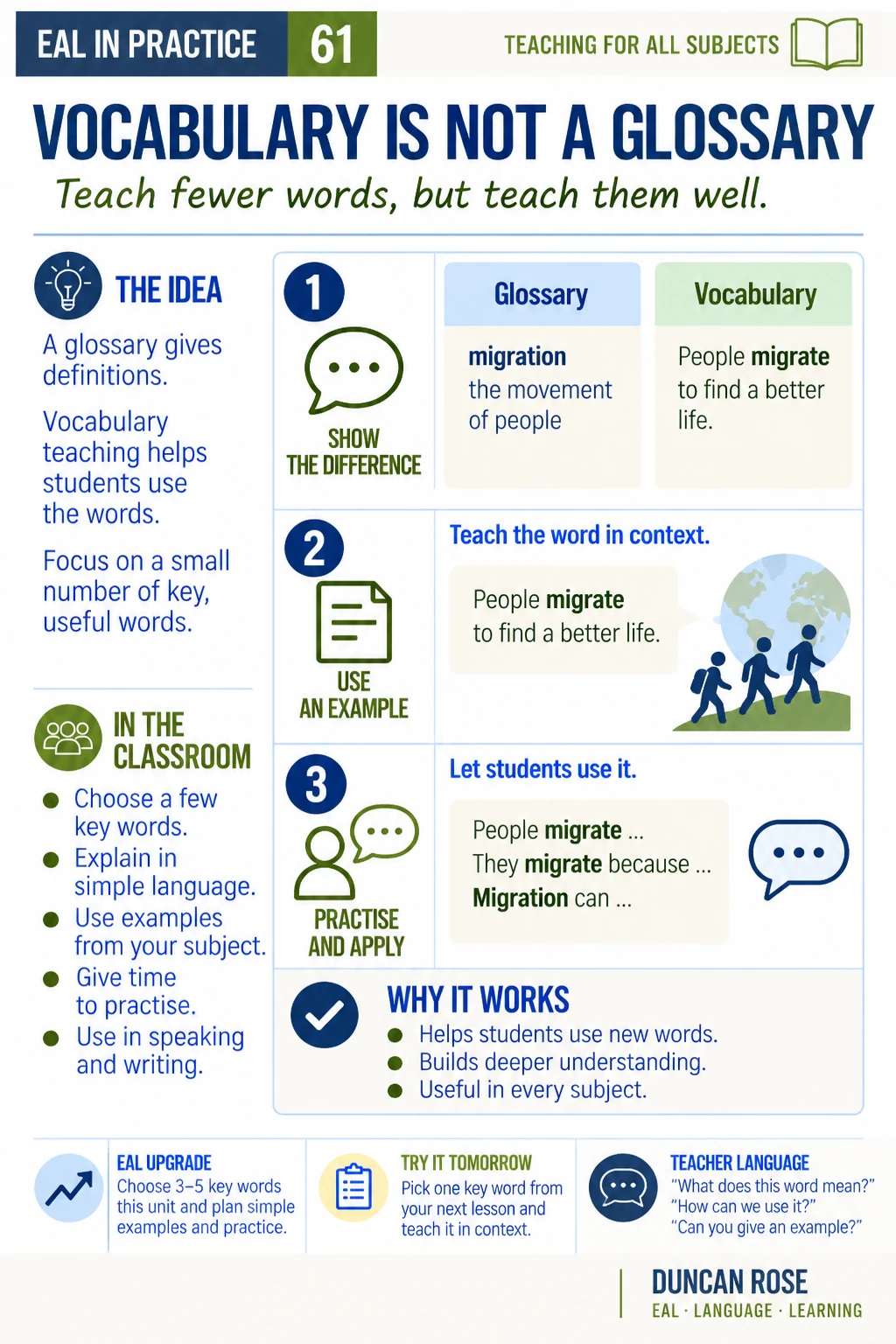 Vocabulary · 5 min prep
Vocabulary Is Not a Glossary
Build relationships between a word, examples, contrasts and uses instead of copying glossary definitions.
Open lesson →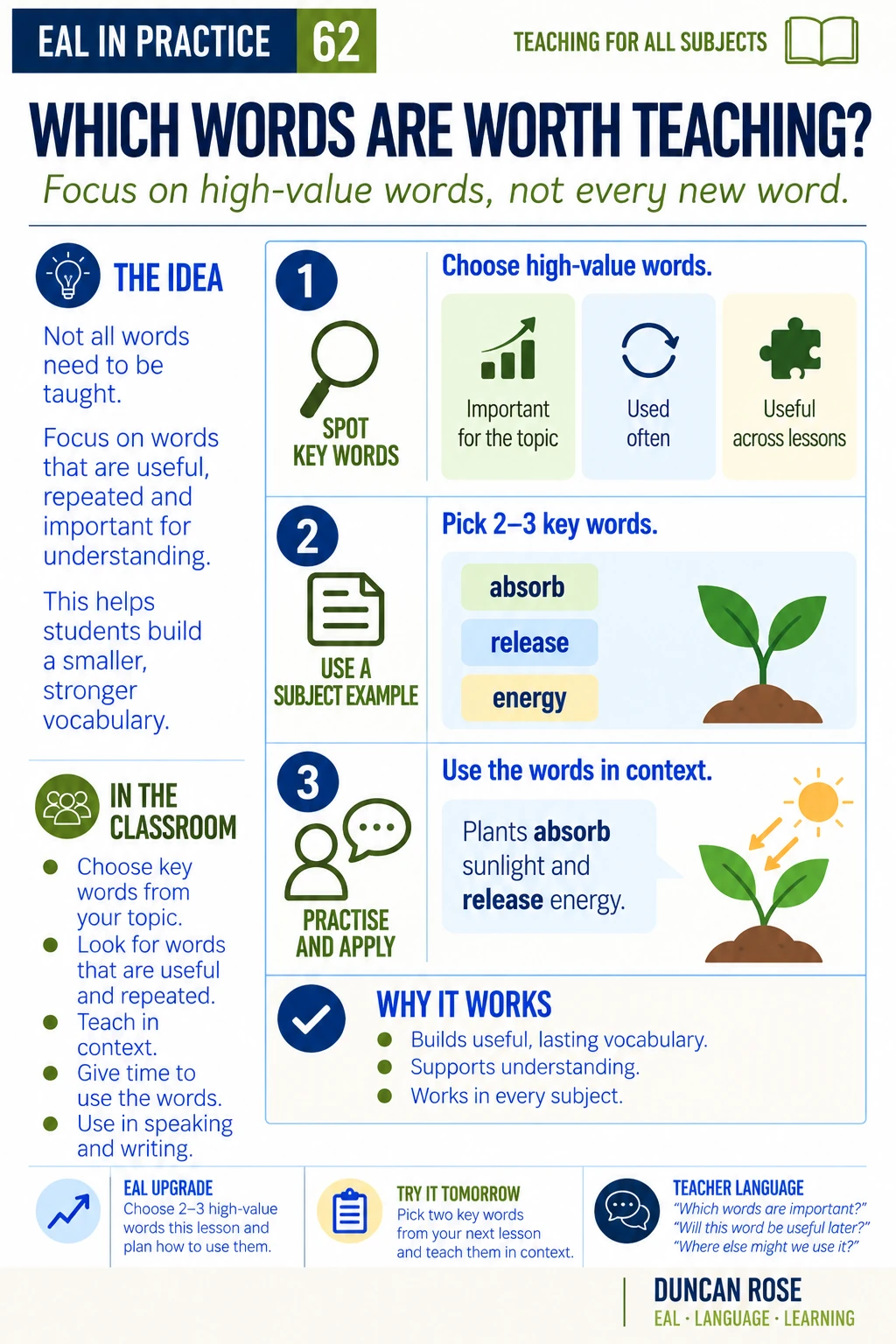 Vocabulary · 5 min prep
Which Words Are Worth Teaching?
Select words according to whether they unlock the next task, recur usefully or express essential concepts.
Open lesson → Vocabulary · 5 min prep
Concept Before Label
Establish the concept through examples and features before introducing its technical label.
Open lesson → Vocabulary · 5 min prep
Technical Words Aren't Always the Problem
Look for blocking general academic words as well as obvious technical terms in the current task.
Open lesson → Vocabulary · 5 min prep
The Vocabulary Iceberg
Map a word's meaning, form, pronunciation, combinations and subject uses to expose knowledge beyond a definition.
Open lesson →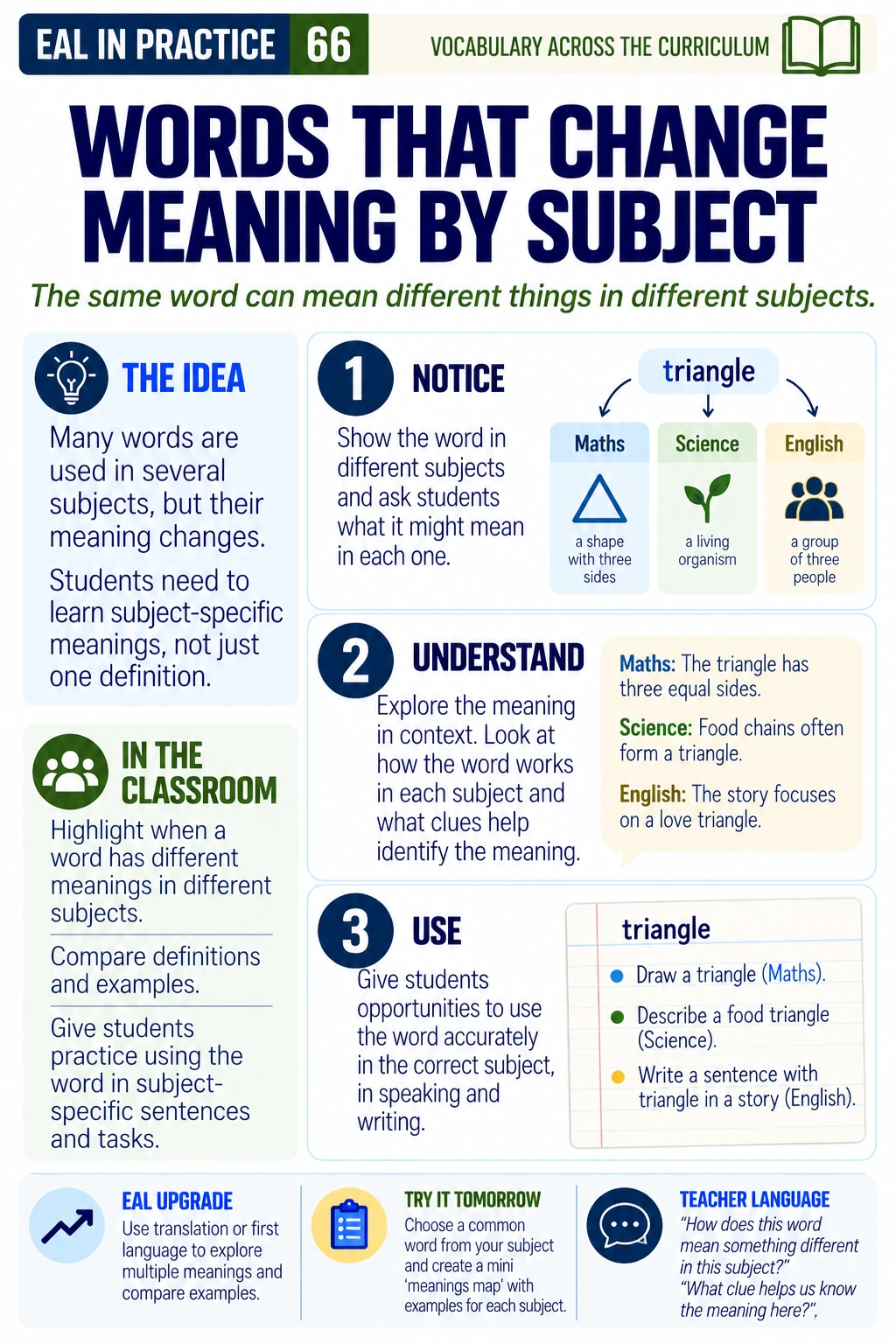 Writing · 5 min prep
Words That Change Meaning by Subject
Compare one word in two subjects and identify where its meaning changes.
Open lesson →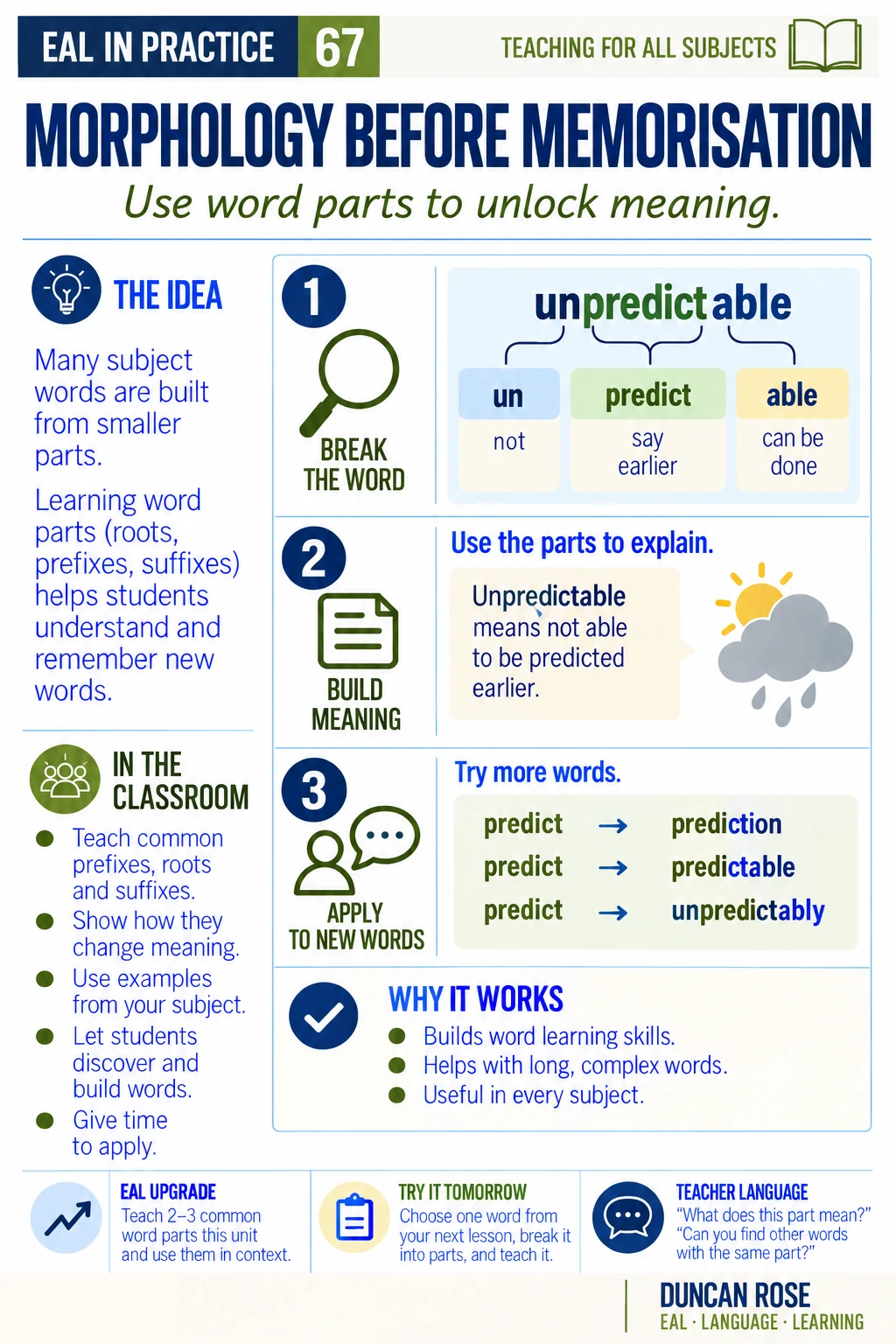 Vocabulary · 5 min prep
Morphology Before Memorisation
Use meaningful word parts to interpret and construct related subject terms before memorising isolated spellings.
Open lesson →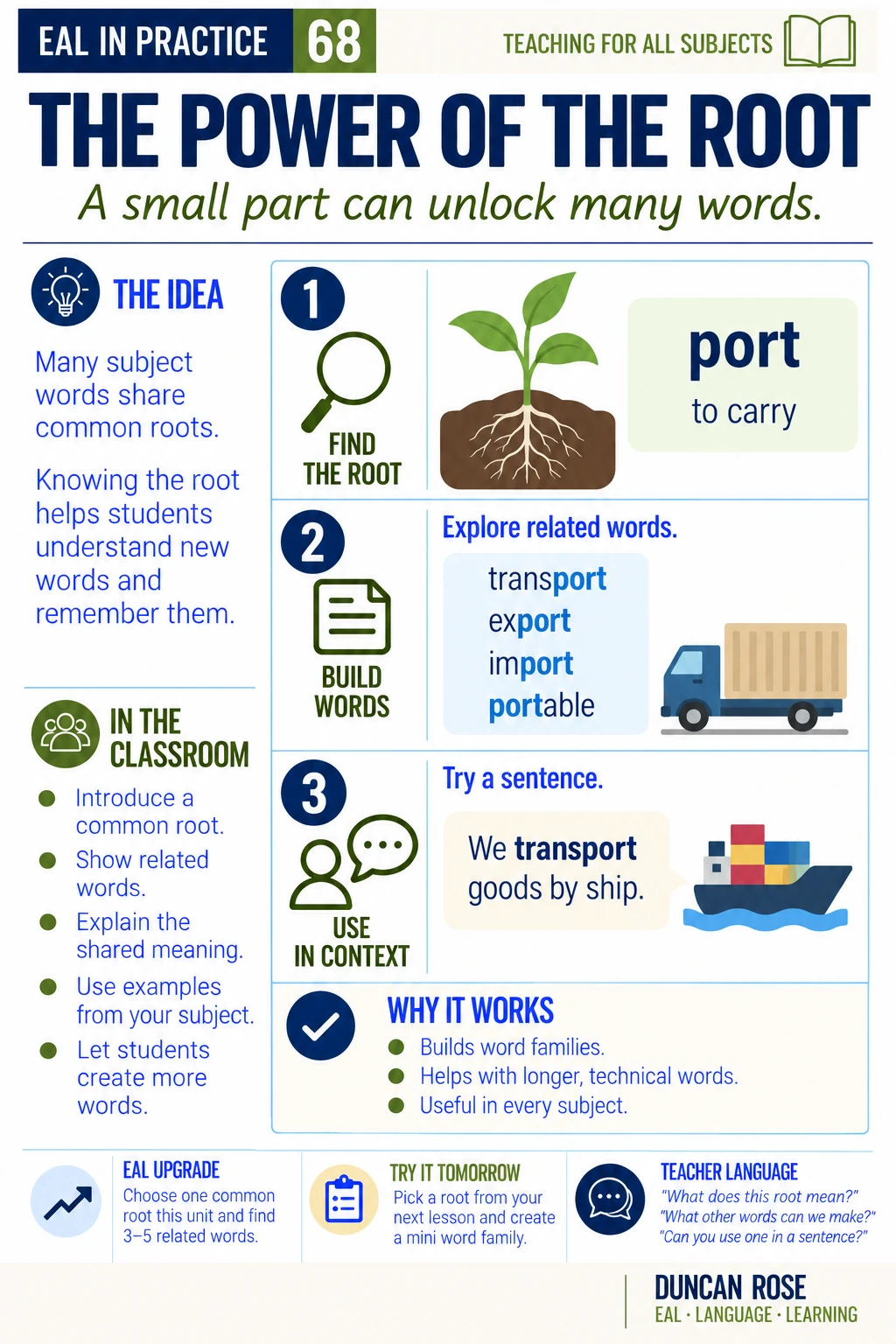 Vocabulary · 5 min prep
The Power of the Root
Trace one root through related words, checking what stays connected and what each affix changes.
Open lesson →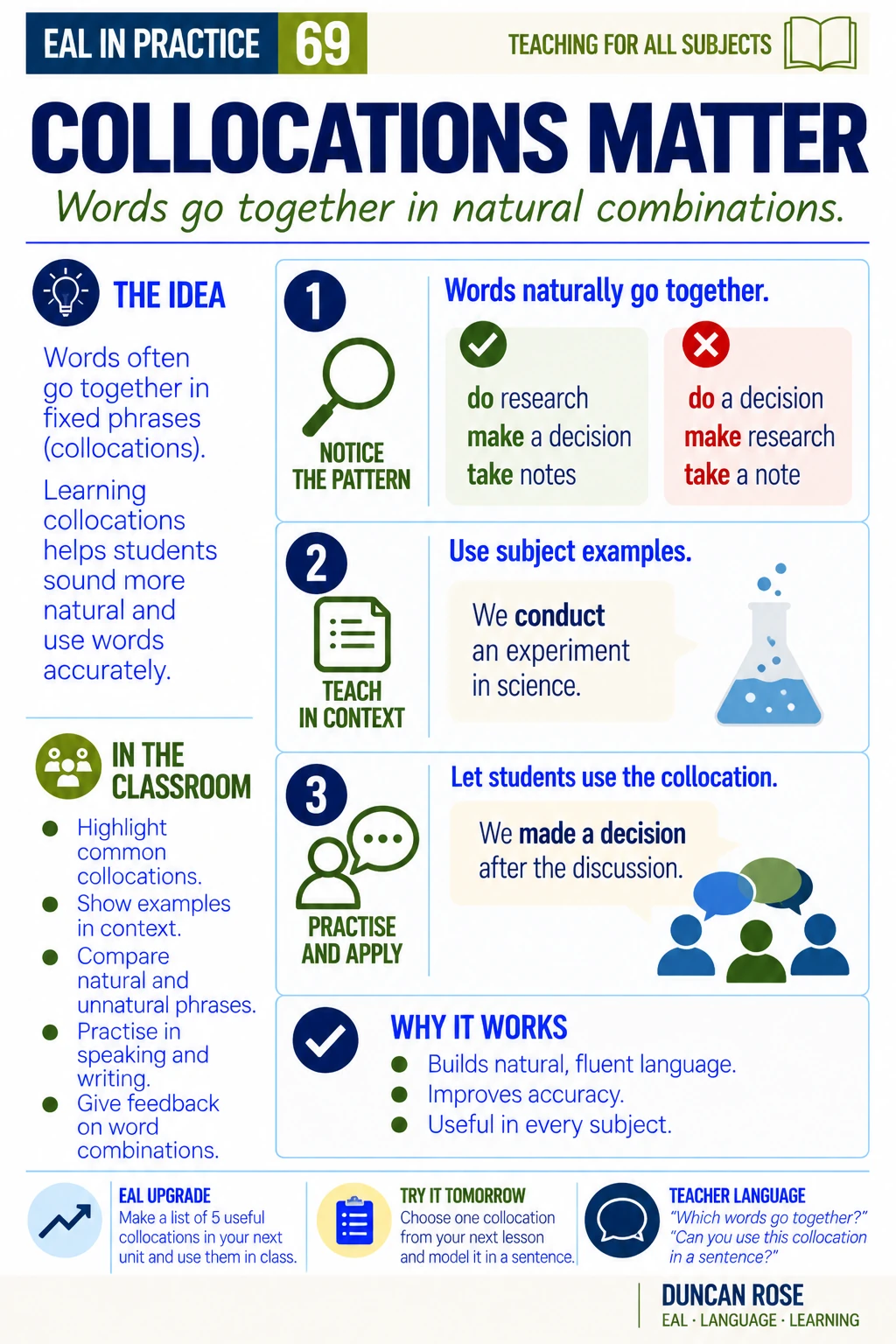 Vocabulary · 5 min prep
Collocations Matter
Teach a subject term together with the words it naturally combines with in the required response.
Open lesson → Vocabulary · 5 min prep
Examples and Non-Examples
Compare a clear example and a near miss so learners identify the defining feature rather than superficial appearance.
Open lesson → Vocabulary · 5 min prep
Build a Vocabulary Network
Create a labelled network around one concept and explain the relationship represented by each connection.
Open lesson → Assessment · 3 min prep
Meet It Again
Revisit a previously taught word through a new task or representation rather than redisplaying the same definition.
Open lesson → Assessment · 3 min prep
Retrieval Beats Re-Reading
Ask learners to recall a meaning before rereading it, then check and correct the recalled response.
Open lesson → Multilingual learning · 5 min prep
Translation Can Save Time
Use a short translation to establish meaning efficiently, then verify it through the subject task.
Open lesson → Vocabulary · 5 min prep
Can They Actually Use the Word?
Check whether a learner can use a word accurately in a fresh subject explanation, not only recognise its definition.
Open lesson →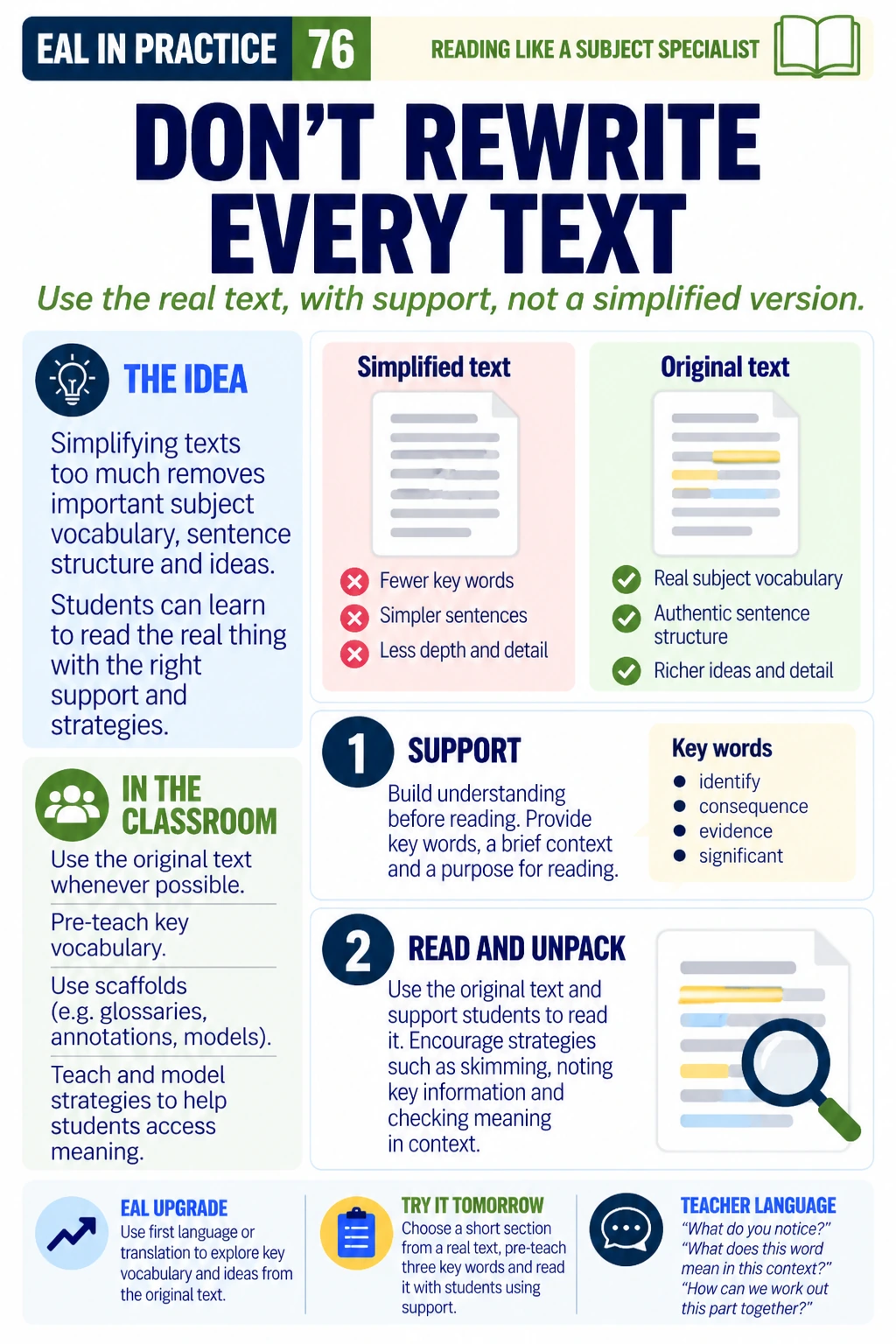 Reading · 5 min prep
Don't Rewrite Every Text
Keep a demanding text intact and select a small access support that addresses its actual reading barrier.
Open lesson → Reading · 5 min prep
Gloss, Don’t Simplify Everything
Place a brief gloss beside a blocking term while preserving the original sentence and its subject relationship.
Open lesson → Reading · 5 min prep
Read for a Reason
Give the text a question worth answering before learners begin reading it.
Open lesson →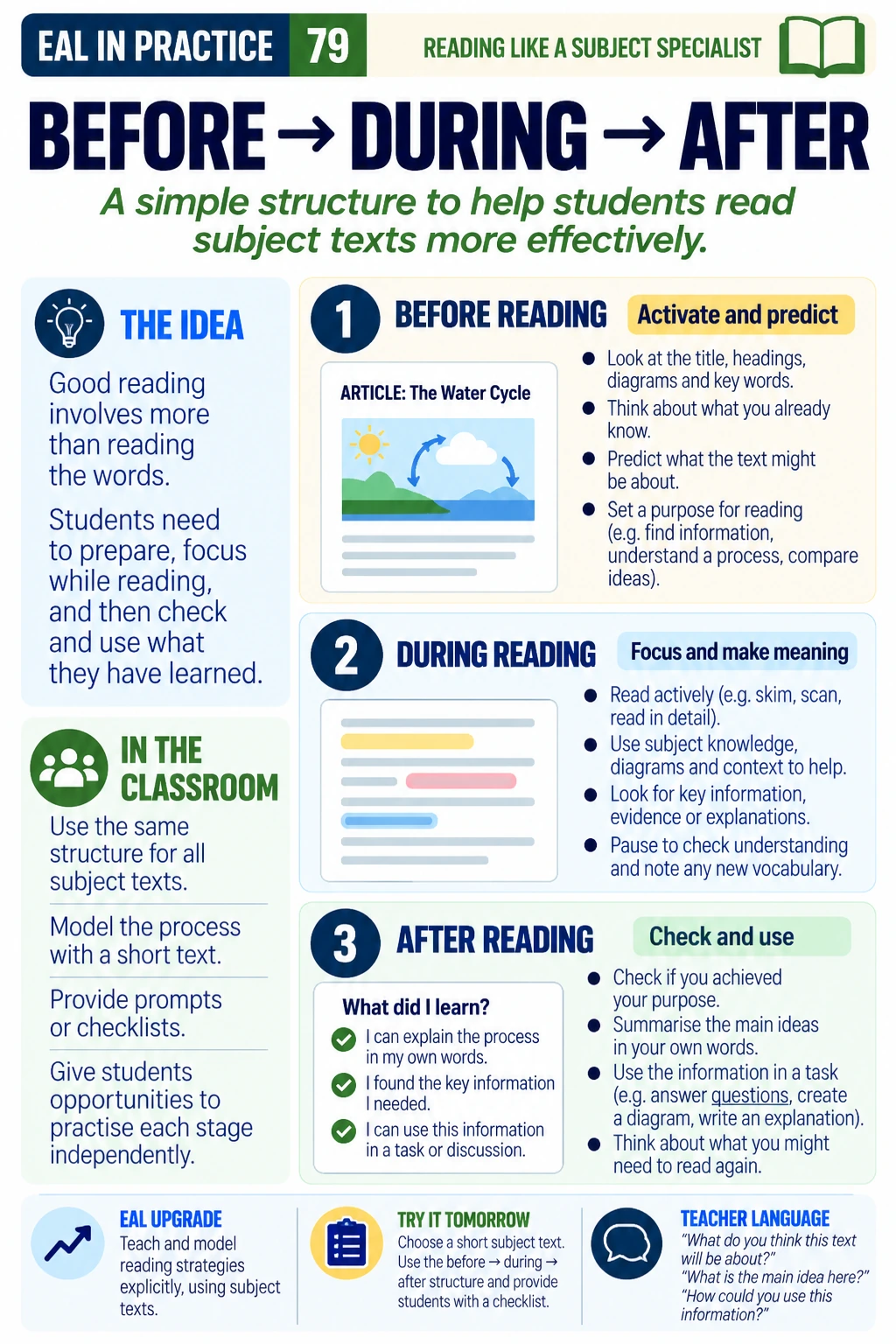 Reading · 5 min prep
Before, During, After: Set the Reading Route
Plan the reading route: set a before-reading question, a during-reading checkpoint and an after-reading return to the purpose.
Open lesson → Reading · 5 min prep
First Read: Gist
Use the first read to establish the central idea without stopping for every unfamiliar word.
Open lesson →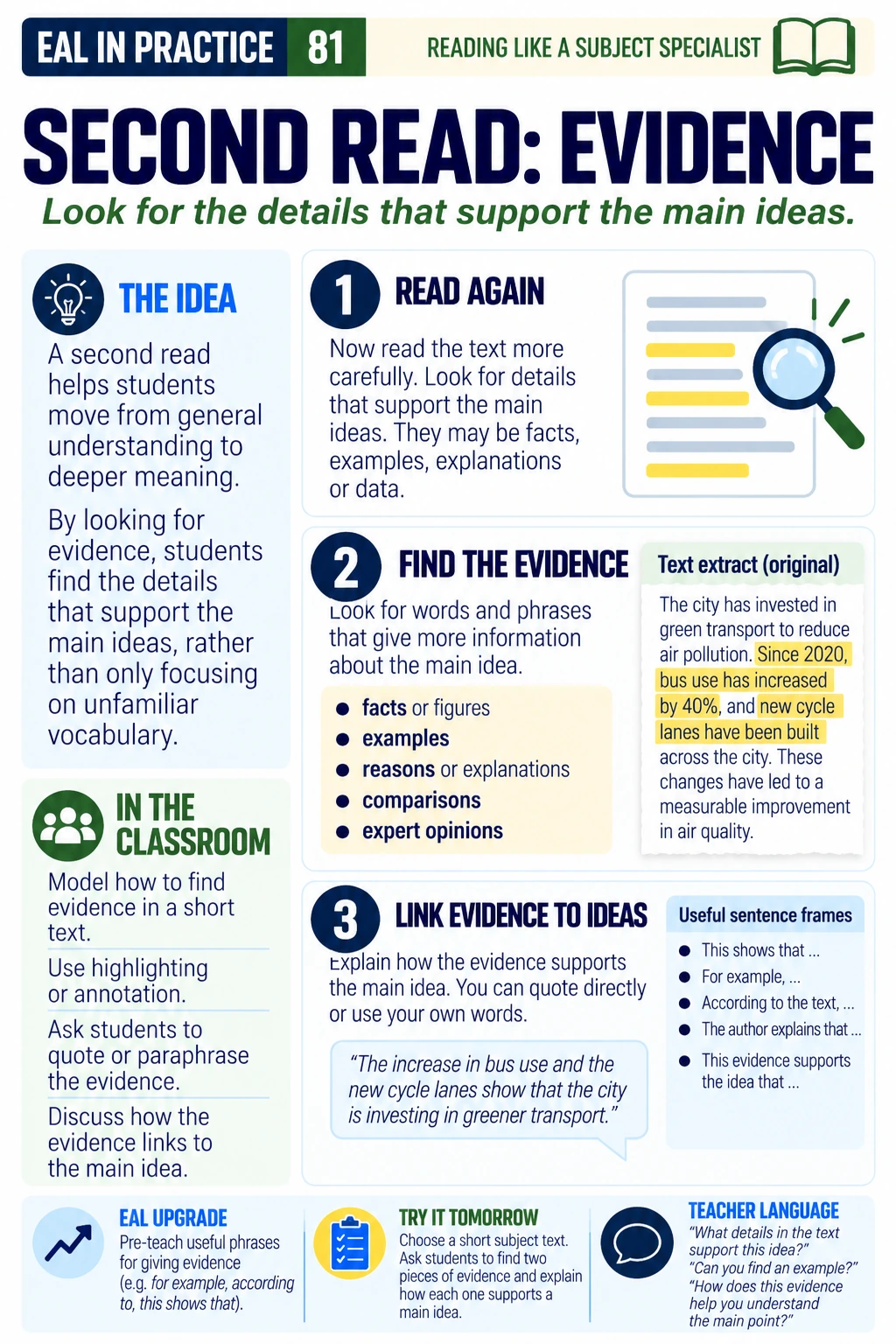 Writing · 5 min prep
Second Read: Evidence
Use a second read to locate and justify the specific evidence needed for the question.
Open lesson → Writing · 5 min prep
Predict Before You Read
Predict a text's likely explanation from its heading and visual, then revise the prediction after reading.
Open lesson →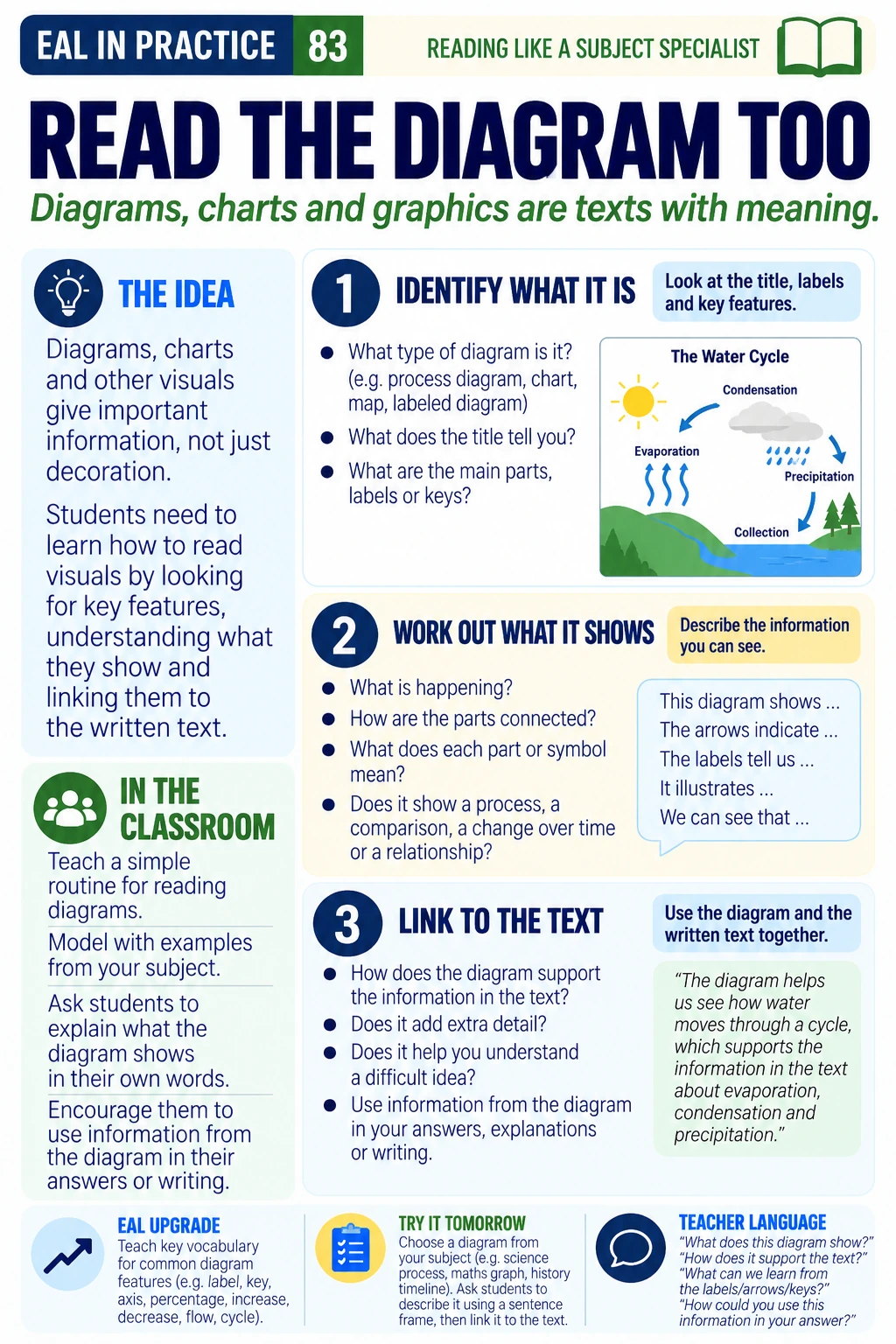 Reading · 5 min prep
Read the Diagram Too
Read the labels, arrows and relationships in a diagram alongside the accompanying prose.
Open lesson → Writing · 5 min prep
How to Read a Science Explanation
Read a science explanation by tracing the cause, mechanism and result across sentences.
Open lesson →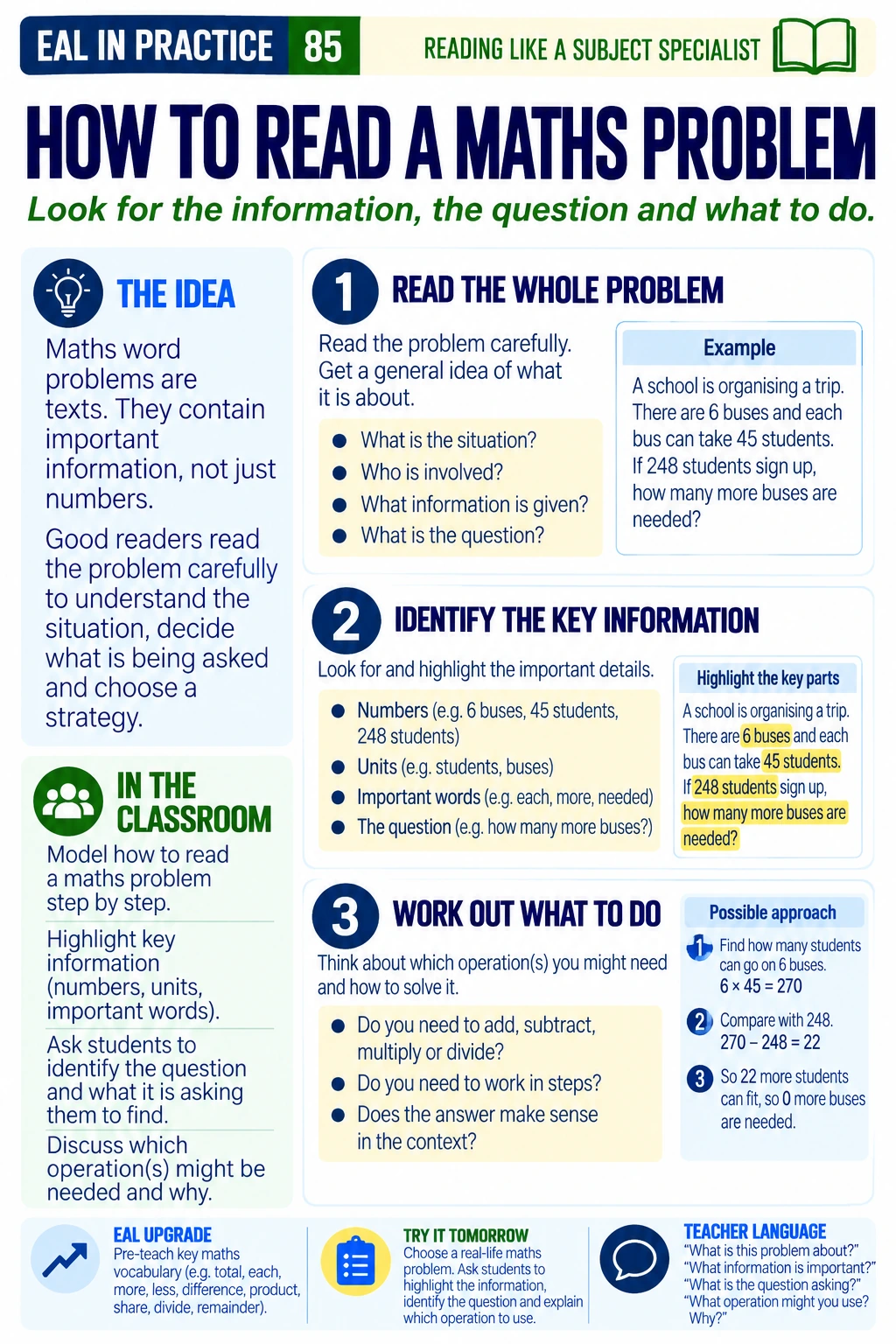 Reading · 5 min prep
How to Read a Maths Problem
Read a maths problem for its situation, quantities and relationship before choosing an operation.
Open lesson → Reading · 5 min prep
How to Read a Historical Source
Establish creator, audience and purpose before interpreting a historical source's message.
Open lesson → Reading · 5 min prep
How to Read a Graph
Read axes, scales, units and intervals before describing or explaining a graph's trend.
Open lesson → Reading · 5 min prep
Read the Diagram Too
Look at the diagram: identify what it shows and the main parts.
Open lesson → Reading · 5 min prep
Sometimes It Isn't Vocabulary
Check sentence relationships, references and structure when known vocabulary still does not produce understanding.
Open lesson →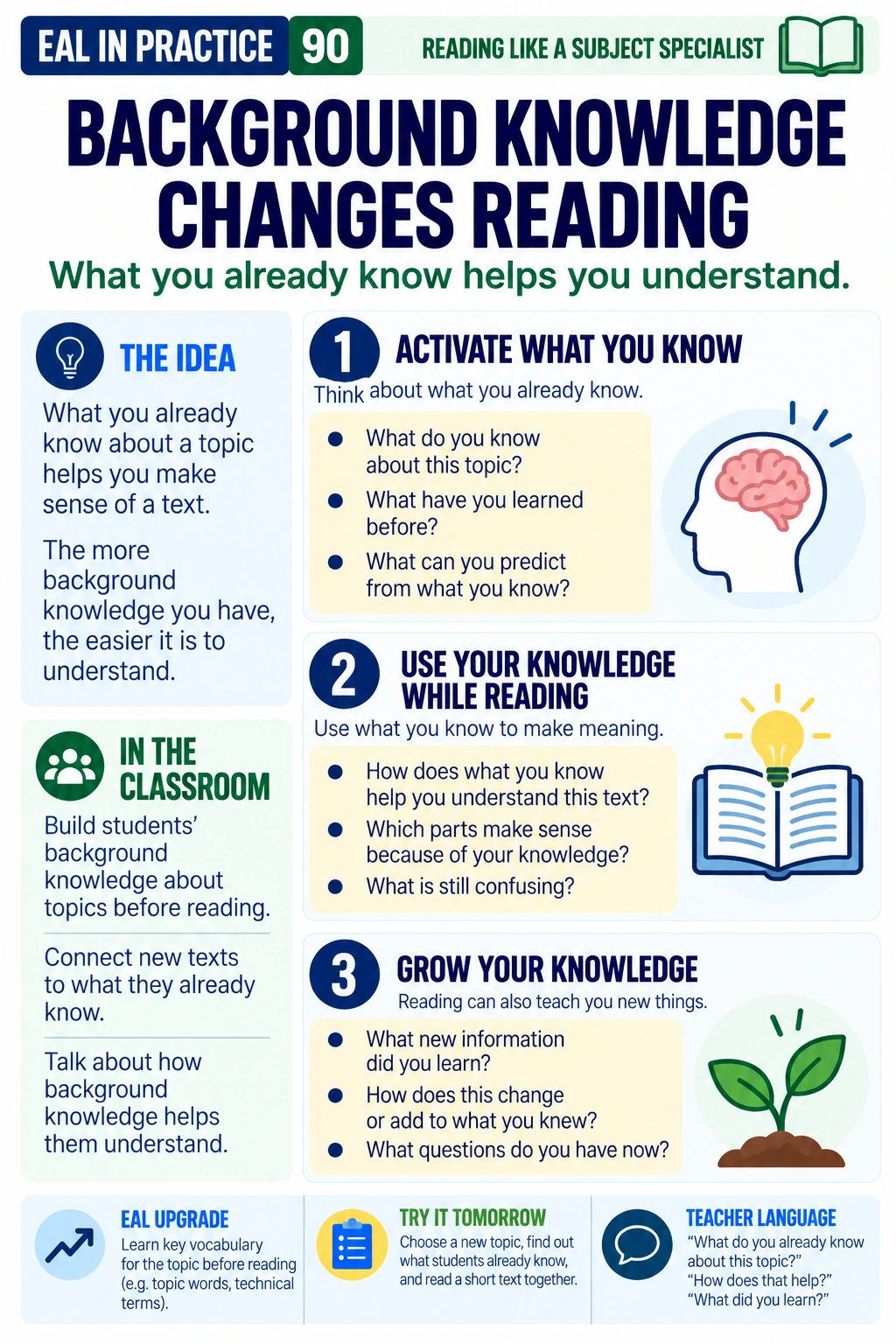 Reading · 5 min prep
Background Knowledge Changes Reading
Activate only the background knowledge needed for this text's meaning and check what learners already know.
Open lesson → Writing · 5 min prep
Writing Starts Before Writing
Prepare ideas and their relationships before expecting an independent written response.
Open lesson → Speaking · 3 min prep
Talk Before You Write
Rehearse the explanation orally, improve an unclear relationship and then write independently.
Open lesson → Writing · 5 min prep
Sentence Before Paragraph
Develop one complete subject sentence with a clear relationship before combining sentences into a paragraph.
Open lesson → Writing · 5 min prep
Model → Notice → Try
Read a model, identify the move that improves its meaning and try that move in a new response.
Open lesson → Writing · 5 min prep
The Worked Example
Reveal why a worked response succeeds by connecting each step to the question and its criteria.
Open lesson → Writing · 5 min prep
Paragraph Frames Aren't Cheating
Use a paragraph frame to organise claim, evidence and explanation while leaving the subject reasoning to the learner.
Open lesson → Assessment · 5 min prep
Fade the Scaffold
Remove one scaffold component and check a fresh response before deciding that support can fade.
Open lesson → Writing · 5 min prep
Sentence Combining
Combine short statements according to their real relationship without losing a fact or qualification.
Open lesson → Writing · 5 min prep
Evidence Needs a Sentence
Turn an evidence item into a sentence that identifies its source or value and links it to the claim.
Open lesson → Reflective practice · 10 min prep
100 Cards: What Actually Helps?
Review which teaching moves improved independent learner responses and identify what still needs adaptation.
Open lesson → Writing · 5 min prep
Writing a Scientific Explanation
Write a scientific explanation that connects an observed result to a relevant mechanism.
Open lesson → Reading · 5 min prep
Writing a Mathematical Explanation
Write a mathematical explanation that justifies a method or relationship, not only its answer.
Open lesson → Reading · 5 min prep
Writing From Evidence in Humanities
Write a humanities interpretation supported by source details and qualified where evidence is limited.
Open lesson → Assessment · 5 min prep
One Feedback Target
Choose one feedback target that would improve the response's meaning and require a revision.
Open lesson → Writing · 5 min prep
Plan in Ideas, Write in Sentences
Plan using short idea notes, then transform those notes into connected sentences rather than copying them as a list.
Open lesson → Speaking · 3 min prep
Silence Isn't Disengagement
Offer a quiet note or sketch before talk so silence can reveal processing rather than being assumed to mean disengagement.
Open lesson → Speaking · 3 min prep
Everybody Rehearses
Give every learner a rehearsal turn and check that each can explain after the pair work.
Open lesson → Assessment · 3 min prep
Stop Asking for Volunteers
Collect a response from everyone before selecting contributions, so the check does not depend on volunteers.
Open lesson → Writing · 5 min prep
Think, Pair and Build on the Evidence
Use pair talk to improve a claim with relevant evidence rather than simply agreeing on an answer.
Open lesson → Speaking · 5 min prep
Give Them the Language to Disagree
Give learners language to challenge a claim respectfully and support the disagreement with evidence.
Open lesson → Speaking · 3 min prep
Build on an Answer
Build on an answer by adding a missing reason, a supporting detail or a justified qualification.
Open lesson → Writing · 5 min prep
Ask for Evidence
Ask for evidence that supports this particular claim and require the learner to explain the link.
Open lesson → Speaking · 3 min prep
From Pair Talk to Public Talk
Move from private rehearsal to pair explanation and then an independent public contribution.
Open lesson → Speaking · 3 min prep
Wait Time: Give the Pause a Thinking Job
Give the pause a thinking job: identify a clue, sketch a relationship or prepare a reason before discussion.
Open lesson → Writing · 5 min prep
Recast Without Interrupting Thinking
Recast one unclear phrase while preserving the learner's idea, then let the learner complete the explanation.
Open lesson → Reading · 5 min prep
Talk Through the Diagram
Talk through a diagram by locating evidence and explaining each labelled relationship.
Open lesson → Reading · 5 min prep
Talk Through the Calculation
Talk through a calculation by explaining why each operation suits the relationship in the problem.
Open lesson → Writing · 5 min prep
Talk Through the Evidence
Talk through an evidence item by naming what it shows and which claim it supports.
Open lesson → Reading · 5 min prep
Practical Work Needs Talk
Build talk into practical work so learners clarify instructions, record observations and explain decisions.
Open lesson → Speaking · 3 min prep
Talk Is Thinking
Use talk to test and improve a relationship in an idea, then collect an individual account of the thinking.
Open lesson → Assessment · 5 min prep
Are You Testing Science or English?
Identify whether a test is intended to reveal science understanding or ability to express that understanding in English.
Open lesson → Reading · 5 min prep
Audit the Language Before the Test
Audit the wording of a test prompt for avoidable language barriers while preserving the assessed reasoning.
Open lesson → Assessment · 5 min prep
Knowledge ≠ English Proficiency
Gather subject knowledge through more than one response mode and record English-expression needs separately.
Open lesson → Reading · 5 min prep
Decode the Exam Question
Decode the exam task verb, evidence source and required answer structure before attempting the response.
Open lesson → Reading · 5 min prep
Teach the Language of Tests
Teach the language of test instructions and response demands using examples from current subject assessment.
Open lesson → Reading · 5 min prep
Clearer Question, Same Challenge
Clarify a question's wording without supplying its answer or removing the intended intellectual challenge.
Open lesson → Assessment · 5 min prep
Can They Explain It Orally?
Use an oral explanation to check the concept, then identify what support is needed for the written version.
Open lesson → Writing · 5 min prep
Show Me What Good Looks Like
Make assessment quality visible through a model and a weaker response judged against the same criteria.
Open lesson → Assessment · 5 min prep
Feedback They Can Actually Use
Give a next-step instruction the learner can act on and check the resulting revision.
Open lesson → Assessment · 5 min prep
Correct Less, Improve More
Prioritise a meaningful improvement instead of correcting every surface error at once.
Open lesson → Assessment · 5 min prep
Untimed Before Timed
Establish what a learner can do without time pressure before interpreting difficulties in a timed version.
Open lesson → Reading · 5 min prep
What Does the Diagram Already Tell Them?
Identify which information is already communicated by the assessment diagram and what the learner still has to infer.
Open lesson → Reading · 5 min prep
When Vocabulary Hides the Maths
Check whether contextual vocabulary is obscuring an otherwise accessible mathematical relationship.
Open lesson → Assessment · 5 min prep
When Language Hides the Science
Use a diagram or oral response to distinguish a science misconception from difficulty expressing the concept.
Open lesson → Assessment · 5 min prep
Assessment Should Teach Too
Use assessment evidence to teach a missing relationship, then check it with a fresh task.
Open lesson → Multilingual learning · 5 min prep
English Only Isn't a Strategy
Choose language use according to the learning purpose instead of treating an English-only rule as the teaching strategy.
Open lesson → Multilingual learning · 5 min prep
Translation Is a Tool
Use translation for a defined meaning check and return to the subject task with the needed English terms.
Open lesson → Multilingual learning · 5 min prep
Translanguaging Needs a Purpose
Set a purpose and a return point for multilingual discussion so it advances the shared learning task.
Open lesson → Multilingual learning · 5 min prep
When L1 Helps
Use a familiar language when it helps establish a concept, organise reasoning or access relevant knowledge.
Open lesson → Multilingual learning · 5 min prep
When L1 Gets in the Way
Check when a translated word or phrase changes the intended meaning and repair it with contextual evidence.
Open lesson → Multilingual learning · 5 min prep
Preview → Learn → Review
Preview the concept in a useful language, learn through the lesson and review it with the shared output terms.
Open lesson → Vocabulary · 5 min prep
Concepts Cross Languages
Connect a concept understood in another language to examples and labels needed in the current subject task.
Open lesson → School provision · 10 min prep
Multilingual ≠ Low Ability
Gather evidence of reasoning and prior knowledge without equating developing English with low intellectual ability.
Open lesson → Multilingual learning · 5 min prep
Think in Your Strongest Language First
Plan a complex explanation in a strong language, then construct the bridge into the required English response.
Open lesson → Multilingual learning · 5 min prep
The Bilingual Brainstorm
Brainstorm relevant ideas in available languages, organise them and select the terms needed for the shared task.
Open lesson → Multilingual learning · 5 min prep
Translate Back
Translate a short response back and check whether the central relationship or qualification has changed.
Open lesson → Vocabulary · 5 min prep
Compare the Two Languages
Compare useful word forms or sentence choices across languages without assuming that every feature maps directly.
Open lesson → Reading · 5 min prep
Home Language Research
Use home-language research to access knowledge, then check source quality and attribute evidence in the final response.
Open lesson → Multilingual learning · 5 min prep
Google Translate Isn't a Pedagogy
Treat a machine translation as a draft meaning aid and test it against context, examples and the required concept.
Open lesson → School provision · 10 min prep
Multilingual Is Normal
Plan routine access for multilingual learners across subjects rather than treating multilingualism as an unusual exception.
Open lesson → School provision · 10 min prep
EAL Is Not an Intervention
Embed language-aware teaching in mainstream provision instead of treating all EAL support as a separate remedial programme.
Open lesson → Department planning · 10 min prep
Who Owns EAL?
Name the responsibilities of subject teachers, EAL specialists and leaders for one shared learner outcome.
Open lesson → Department planning · 10 min prep
Every Teacher Teaches Their Subject's Language
Identify the language through which learners explain, justify or interpret in a particular subject task.
Open lesson → Department planning · 10 min prep
The Five-Minute Language Audit
Audit one imminent task for its content goal, language demand, likely barrier and smallest useful support.
Open lesson → Department planning · 10 min prep
What Would an EAL-Friendly Science Lesson Look Like?
Plan a science lesson that keeps the concept demanding while connecting diagrams, vocabulary and explanation language.
Open lesson → Department planning · 10 min prep
What Would an EAL-Friendly Maths Lesson Look Like?
Plan a maths lesson that separates the mathematical relationship from avoidable contextual language barriers.
Open lesson → Department planning · 10 min prep
What Would an EAL-Friendly Humanities Lesson Look Like?
Plan a humanities lesson that supports source access, interpretation, evidence and qualification.
Open lesson → Reading · 5 min prep
What Would an EAL-Friendly Practical Look Like?
Plan practical access through equipment language, safe instructions, observations and evaluation.
Open lesson → Department planning · 10 min prep
Plan Content and Language Together
Specify the content goal and the language learners need to show it in the same lesson plan.
Open lesson → Department planning · 10 min prep
Co-Teaching Needs a Purpose
Agree a purpose for co-teaching, allocate complementary roles and review evidence from the shared task.
Open lesson → Reflective practice · 10 min prep
Support Without Dependency
Identify which support enables progress and test whether the learner can now perform with less of it.
Open lesson → Department planning · 10 min prep
Plan Together, Not Beside Each Other
Plan one task together with shared criteria and complementary roles rather than preparing two parallel lessons.
Open lesson → Department planning · 10 min prep
What Should the EAL Specialist Actually Do?
Connect the EAL specialist's expertise to the task's language demand, modelling and evidence review.
Open lesson → School provision · 10 min prep
Withdrawal Isn't the Default
Choose classroom or withdrawal support from the identified learning need and review its transfer to subject access.
Open lesson → Department planning · 10 min prep
Make Yourself Less Necessary
Build subject-teacher capacity to use and review effective language routines without constant specialist prompting.
Open lesson → School provision · 10 min prep
The Multilingual Classroom Audit
Audit participation, task access and response opportunities in one multilingual classroom before deciding the next improvement.
Open lesson → School provision · 10 min prep
What Does Good EAL Provision Look Like?
Judge EAL provision through learner access, progress, appropriate support and shared responsibility.
Open lesson → School provision · 10 min prep
EAL Data Should Change Teaching
Translate EAL evidence into a concrete teaching decision, then check whether the decision improved the next response.
Open lesson → School provision · 10 min prep
One Language Score Isn't a Profile
Describe strengths and needs across skills and tasks instead of reducing the learner to one proficiency score.
Open lesson → School provision · 10 min prep
Track Progress, Not Just Proficiency
Compare responses over time using the same learning goal and note changes in independence as well as proficiency.
Open lesson → School provision · 10 min prep
Who Actually Needs EAL Support?
Identify support needs from task access and learning evidence rather than a language label alone.
Open lesson → School provision · 10 min prep
When Should Support End?
Review ending or reducing support using sustained independent performance across relevant tasks and settings.
Open lesson → School provision · 10 min prep
EAL Is Not SEN
Distinguish language-development needs from other persistent learning concerns through history, access and response to teaching.
Open lesson → School provision · 10 min prep
EAL and SEN Can Coexist
Plan language access and identified learning support together when EAL and SEN needs coexist.
Open lesson → School provision · 10 min prep
The Multilingual Learner Journey
Track a learner's changing access, language strengths and independence across a sequence of learning.
Open lesson → School provision · 10 min prep
Parents Are Language Partners
Invite families' knowledge of languages and learning history and communicate a practical shared support goal.
Open lesson → Department planning · 10 min prep
Put Language in the Curriculum Plan
Include the language demands and planned support in the curriculum sequence alongside subject content.
Open lesson → School provision · 10 min prep
What Should an EAL Policy Actually Do?
Turn an EAL policy into actions, responsibilities, resources and a review process teachers can use.
Open lesson → School provision · 10 min prep
From EAL Department to Multilingual School
Build shared language-aware routines across departments while retaining specialist expertise and evidence review.
Open lesson → Reflective practice · 10 min prep
EAL IN PRACTICE: What 180 Cards Taught Us
Review the collection by asking which routines produced better access, reasoning and independence for learners.
Open lesson →Classroom strategies · 5 min prep3–2–1 Language Exit Ticket
Use a 3–2–1 exit ticket to capture what learners remember, which language they can use and what still needs attention.
Open lesson →Classroom strategies · 5 min prepActivate Knowledge. Build Curiosity. Improve Understanding
Reconnect learners with what they know, then use a question to create a reason to read or investigate.
Open lesson →Reading · 5 min prepBefore, During, After: Process and Reconstruct
Process the text through meaningful pauses, then reconstruct how its parts contribute to the whole.
Open lesson →Classroom strategies · 5 min prepBreak Big Texts into Smaller, Manageable Parts
Break a long text into short, purposeful sections with one manageable reading job at a time.
Open lesson →Classroom strategies · 5 min prepBuild a Framework Before the Details
Give learners a simple structure for organising ideas before they meet the detail of a complex topic.
Open lesson →Classroom strategies · 5 min prepConnect the Visuals and the Words
Make the relationship between a visual and its language explicit through looking, matching, labelling and explanation.
Open lesson →Classroom strategies · 5 min prepDevelop Language Flexibility. Improve Expression
Help learners move between everyday, technical and formal wording while keeping the intended meaning clear.
Open lesson →Classroom strategies · 5 min prepDevelop Precision. Build Language
Replace vague words with precise vocabulary that names the process, quantity or relationship more accurately.
Open lesson →Classroom strategies · 5 min prepEveryday → Academic: Stronger Verbs, Stronger Writing
Turn everyday verbs into accurate academic verbs that make the action in a sentence clearer.
Open lesson →Classroom strategies · 5 min prepExplore a Question from Every Angle
Explore an open question from several perspectives before choosing and supporting a conclusion.
Open lesson →Classroom strategies · 5 min prepGive Language. Build Confidence. Get Better Answers
Give learners a small set of useful words and sentence frames so more of them can contribute precise answers.
Open lesson →Classroom strategies · 5 min prepLess Is More: Focus on What Matters
Reduce a crowded task to its essential learning focus, then return optional detail once the main idea is secure.
Open lesson →Classroom strategies · 5 min prepListen, Pair, Share: More Talk, Better Listening
Build attentive listening into a short routine: listen to an idea, discuss it, then listen again for evidence.
Open lesson →Classroom strategies · 5 min prepMake Expectations Visible
Make the learning goal, task steps and success criteria visible so students can check their own progress.
Open lesson →Classroom strategies · 5 min prepOne Idea Per Step: Simplify Complex Instructions
Give one action at a time when a task has several instructions, then check understanding before moving on.
Open lesson →Classroom strategies · 5 min prepPre-Teach Less
Pre-teach only the few words learners need to access the upcoming text; leave the rest for reading in context.
Open lesson →Classroom strategies · 5 min prepPre-Teach Less. Remember More
Use brief spaced retrieval to help learners remember a small number of essential words over time.
Open lesson →Classroom strategies · 5 min prepPre-Teach to Unlock the Text
Pre-teach a key word when it unlocks the main idea, then return to it in the text and task.
Open lesson →Classroom strategies · 5 min prepProcess Text in Manageable Pieces
Process a long or dense text in manageable sections, connecting each part to the text’s overall meaning.
Open lesson →Classroom strategies · 5 min prepQuick Practice Games: Listening & Literacy (18A)
Use short listening and literacy games to retrieve key words, follow instructions and notice sound–meaning links.
Open lesson →Classroom strategies · 5 min prepQuick Practice Games: Listening & Literacy (18B)
Vary a short listening or literacy game so learners practise the same target through a new route.
Open lesson →Classroom strategies · 5 min prepRevision & Memory: Look Back, Recall More, Remember Better
Help learners remember more by combining short review, retrieval and correction rather than rereading alone.
Open lesson →Classroom strategies · 5 min prepSee It. Say It. Use It
Connect seeing a new word, saying it clearly and using it meaningfully in a subject context.
Open lesson →Classroom strategies · 5 min prepThe EAL-Friendly Slide
Design slides so the language, visual and task are easy to read and directly support the lesson goal.
Open lesson →Classroom strategies · 5 min prepThink, Pair, Share: More Thinking Time, Better Conversations
Give every learner quiet thinking time before pair discussion so more voices can enter with an idea ready.
Open lesson →Assessment · 3 min prepWait Time: Check What the Pause Changes
Check what the pause changes: compare a first response with a response after purposeful thinking or rehearsal.
Open lesson →Speaking · 5 min prepStart with the Object
Place one real object on each table. Learners name what they notice before you introduce the new topic words.
Open lesson →Writing · 5 min prepThe Two-Minute Sketch
Ask learners to sketch the process from memory, then label only the parts they can name.
Open lesson →Reading · 5 min prepShow Me the First Move
Display the task and ask pairs to point to the first action before anyone begins.
Open lesson →Writing · 5 min prepBuild the Answer in Layers
Write a short answer in three passes: idea, evidence, then the link between them.
Open lesson →Speaking · 3 min prepThe Quiet Think First
Give everyone thirty seconds to write one idea before the first person speaks.
Open lesson →Vocabulary · 5 min prepChoose the Better Example
Show two examples; learners choose the stronger one and point to the feature that makes it work.
Open lesson →Writing · 5 min prepTurn Notes into a Sentence
Give learners three key notes and ask them to combine them into one clear subject sentence.
Open lesson →Assessment · 3 min prepThe Misconception Snapshot
Use one deliberately flawed example. Learners mark the first point where the reasoning goes wrong.
Open lesson →Writing · 5 min prepName the Change
Present before-and-after examples and ask learners to describe what changed using the target term.
Open lesson →Reading · 5 min prepOne Question, Three Ways
Rephrase the same question as a drawing prompt, a short spoken prompt and a written prompt.
Open lesson →Reading · 5 min prepThe First Thirty Seconds
Use a short timed start: read the task, circle the action, underline the topic, begin one step.
Open lesson →Writing · 5 min prepCompare the Two Models
Place a complete answer beside a nearly complete one. Learners identify the single missing move.
Open lesson →Vocabulary · 5 min prepThe Example Ladder
Order three examples from easiest to hardest and explain what additional thinking each one needs.
Open lesson →Assessment · 3 min prepPause at the Hinge
Stop midway through a worked example. Learners predict the next step and give a reason.
Open lesson →Assessment · 3 min prepEnd with One Useful Sentence
Before leaving, learners write one sentence that explains what changed in their thinking.
Open lesson →Reading · 5 min prepPut the Task in Three Boxes
Separate the prompt into what to do, what to use and what a successful answer needs.
Open lesson →Reading · 5 min prepPreview the Diagram Labels
Cover the labels, let learners predict them, then reveal and discuss unfamiliar terms.
Open lesson →Reading · 5 min prepGive the Text a Clear Route
Number the paragraph, diagram and question in the order learners should use them.
Open lesson →Writing · 5 min prepUse a Worked First Line
Complete the opening line of a response, then ask learners to continue with their own evidence.
Open lesson →Assessment · 5 min prepOffer a Choice of Starting Point
Let learners begin with the diagram, key terms or short text, then bring everyone to the same task.
Open lesson →Reading · 5 min prepTeach the Page Before the Task
Spend one minute showing how to find the heading, key, units and source on the page.
Open lesson →Reading · 5 min prepChunk the Practical Instructions
Present one safe action at a time; ask a learner to restate it before equipment is used.
Open lesson →Writing · 5 min prepMake the Success Criteria Visible
Turn each criterion into a small check box learners can revisit while working.
Open lesson →Vocabulary · 5 min prepPlace a Vocabulary Bank Beside the Evidence
Put three relevant words next to the graph, source or model where learners will need them.
Open lesson →Speaking · 3 min prepOffer a Low-Stakes Rehearsal
Let pairs try the response orally before writing the assessed version.
Open lesson →Reading · 5 min prepShow the Hidden Step
Model the small inference between the evidence learners can see and the conclusion they need.
Open lesson →Assessment · 5 min prepKeep One Challenge, Add One Support
Retain the same subject question and add a single model, visual cue or rehearsal.
Open lesson →Writing · 5 min prepSort Claim from Evidence
Give learners mixed statements and data; sort them into what is claimed and what can be observed.
Open lesson →Writing · 5 min prepAdd the Missing Because
Remove the causal link from a model answer. Learners supply a because clause that connects evidence to claim.
Open lesson →Writing · 5 min prepRank Explanations by Strength
Compare three explanations and rank them by how well they use evidence and subject knowledge.
Open lesson →Reasoning · 5 min prepDraw the Inference Chain
Connect observation, concept and conclusion with arrows; learners explain each link aloud.
Open lesson →Reasoning · 5 min prepSpot the Assumption
Show a conclusion and ask what must be true for it to follow from the evidence.
Open lesson →Writing · 5 min prepQualify the Conclusion
Add a limit or condition to an overconfident statement using may, suggests or in this case.
Open lesson →Writing · 5 min prepChange the Variable
Keep a science or maths explanation but change one condition; learners predict which part of the reasoning changes.
Open lesson →Reasoning · 5 min prepChoose a Counterexample
Ask learners to find a case that would challenge a broad rule and revise the rule accordingly.
Open lesson →Reading · 5 min prepExplain the Wrong Turn
Present an incorrect solution and ask learners to explain the thinking that may have produced it.
Open lesson →Writing · 5 min prepLink Cause to Consequence
Arrange a set of events or processes and connect each cause to its consequence in a full sentence.
Open lesson →Reading · 5 min prepSeparate Observation and Interpretation
Use an image or data set; label what is directly visible and what is an interpretation.
Open lesson →Writing · 5 min prepFinish the Reasoning
Give a claim and evidence, then ask learners to complete the reasoning that connects them.
Open lesson →Vocabulary · 5 min prepBuild a Word Family Card
Record a root word, two related forms and a sentence showing how each form works in the subject.
Open lesson →Vocabulary · 5 min prepMatch Words to Real Examples
Place technical terms beside examples from a current unit; learners justify each match.
Open lesson →Vocabulary · 5 min prepFind the Word Neighbour
Choose a target term and collect words that commonly appear before or after it in subject texts.
Open lesson →Vocabulary · 5 min prepUse a Four-Box Vocabulary Grid
Add meaning, image, example and non-example for a word learners will meet in the next lesson.
Open lesson →Writing · 5 min prepTrace a Word Across Subjects
Compare one shared word, such as volume or factor, across two subject contexts.
Open lesson →Assessment · 3 min prepRetrieve Before Revealing
Ask for a definition and example from memory, then reveal the class reference and refine it.
Open lesson →Vocabulary · 5 min prepSort by Word Job
Group key words as things, actions, qualities or relationships, then use one from each group.
Open lesson →Writing · 5 min prepMake a Precision Scale
Arrange near-synonyms from least to most precise for the current concept.
Open lesson →Vocabulary · 5 min prepTeach the Prefix in Context
Highlight a prefix in a unit term and use it to predict the meaning of an unfamiliar related word.
Open lesson →Vocabulary · 5 min prepPair the Verb and Noun
Match process verbs with the nouns they typically act on, then make a subject sentence.
Open lesson →Vocabulary · 5 min prepKeep a Personal Word Record
Learners record a new term, an example from class and one question they still have.
Open lesson →Assessment · 3 min prepRevisit a Word in a New Setting
Use a familiar term in a fresh example and ask learners to explain what stays the same and what changes.
Open lesson →Reading · 5 min prepRead the Caption Before the Image
Cover an illustration and read its caption first; predict what evidence the image should contain.
Open lesson →Reading · 5 min prepTrack One Idea Through a Text
Follow one concept across a short passage and mark each sentence that adds to it.
Open lesson →Reading · 5 min prepMark the Source and the Claim
Highlight who produced a text and underline the claim they are making.
Open lesson →Reading · 5 min prepRead the Axis Before the Trend
Read a graph title, axis labels and units before describing the pattern.
Open lesson →Writing · 5 min prepFind the Sentence That Does the Work
Ask learners to select the sentence that most directly answers a question and explain why.
Open lesson →Reading · 5 min prepUse a Margin Question
Write a simple question beside each paragraph before reading it closely.
Open lesson →Reading · 5 min prepCompare Text and Diagram
Read a short explanation alongside its diagram; identify one detail each provides that the other does not.
Open lesson →Reading · 5 min prepFollow the Pronoun Trail
Trace it, they or this back to the noun it refers to in a subject explanation.
Open lesson →Reading · 5 min prepRead the Problem in Passes
First find the situation, then the values, then the operation or relationship requested.
Open lesson →Reading · 5 min prepNotice the Writer’s Signal
Find a word such as however, therefore or although and explain what relationship it signals.
Open lesson →Reading · 5 min prepSeparate Fact from Viewpoint
Mark statements that can be checked against evidence and statements that express a viewpoint.
Open lesson →Writing · 5 min prepSummarise Without the Topic Words
Explain the main idea in everyday language, then restore the precise subject vocabulary.
Open lesson →Reading · 5 min prepCompare Two Accounts
Read two short sources and mark what both agree on and where their explanations differ.
Open lesson →Writing · 5 min prepChoose Evidence for a Question
Give learners a question and three extracts; choose the extract that best supports an answer.
Open lesson →Writing · 5 min prepTurn a Diagram into a Paragraph
Label the sequence in a diagram, then use those labels to write a connected explanation.
Open lesson →Writing · 5 min prepWrite the Comparison Link
Provide two data points and a frame: both…, whereas… Learners complete it with accurate values.
Open lesson →Vocabulary · 5 min prepBuild a Definition from Features
List what a concept does, what it includes and how it differs from a related concept; combine into a definition.
Open lesson →Writing · 5 min prepDraft from Evidence Cards
Arrange three evidence cards, then write a claim that uses at least two of them.
Open lesson →Writing · 5 min prepUse a Sentence Combining Pass
Combine short subject sentences with because, although or which to show their relationship.
Open lesson →Writing · 5 min prepWrite the Method in Order
Give practical actions out of order; sequence them and write each as a clear instruction.
Open lesson →Writing · 5 min prepTurn a Table into a Finding
Choose the most useful comparison in a table and write what it suggests.
Open lesson →Writing · 5 min prepAdd a Precise Qualifier
Find a broad statement in a draft and revise it with a limit supported by the evidence.
Open lesson →Writing · 5 min prepWrite the Caption That Matters
Draft a caption that tells the reader what a figure shows and why it matters.
Open lesson →Writing · 5 min prepExplain a Choice in Two Sentences
Write the decision first, then support it with one piece of subject evidence.
Open lesson →Writing · 5 min prepRevise for the Reader
Swap drafts and mark one place where a reader needs a clearer link, term or reference.
Open lesson →Writing · 5 min prepComplete the Final Sentence
Provide the opening and evidence of an explanation; learners write the final causal sentence.
Open lesson →Writing · 5 min prepBuild a Short Response from Notes
Turn five unordered notes into a topic sentence, two evidence sentences and a closing link.
Open lesson →Writing · 5 min prepUse a Peer Check for Meaning
Partners underline the claim, circle the evidence and ask about any missing reasoning.
Open lesson →Vocabulary · 5 min prepRehearse a Definition with an Example
One learner defines a current term; a partner asks for a concrete example and checks the key feature.
Open lesson →Reading · 5 min prepUse a Data Point as a Prompt
Give pairs one value from a graph; they explain what it means and what it does not show.
Open lesson →Writing · 5 min prepAsk for a Better Reason
After a learner gives an answer, invite a partner to ask what evidence would make the reason stronger.
Open lesson →Speaking · 5 min prepThink-Pair-Report with Roles
One partner explains the idea, the other listens for a key term, then reports the idea using it.
Open lesson →Reading · 5 min prepCompare Two Interpretations
Pairs study an image or source and each offer an interpretation supported by one visible detail.
Open lesson →Speaking · 3 min prepPractise the Question Stem
Use “What makes you think that?” and “Which detail supports it?” to extend a short answer.
Open lesson →Reading · 5 min prepExplain a Procedure to a Partner
One learner gives the steps without touching the equipment; partner follows and asks for clarification.
Open lesson →Speaking · 3 min prepUse a Wait-and-Add Round
Each speaker adds a new reason or example; repeating the previous point is not allowed.
Open lesson →Speaking · 5 min prepHold a Mini Evidence Debate
Assign two interpretations of the same data; learners must cite one value before responding.
Open lesson →Speaking · 5 min prepTeach Back One Step
After modelling a process, learners explain one step to a partner using the correct verb.
Open lesson →Speaking · 3 min prepMake a Clarification Request
Practise asking “Do you mean…?” and “Can you show me where…?” during a group task.
Open lesson →Writing · 5 min prepEnd a Discussion with a Summary
A final speaker sums up the shared idea and names one point the group still needs to test.
Open lesson →Speaking · 5 min prepUse an Expert and Checker
One learner gives a solution; the checker asks for the reason behind each step.
Open lesson →Reading · 5 min prepPair-Led Diagram Walkthrough
Partners take turns explaining a different part of one shared diagram and how the parts connect.
Open lesson →Reading · 5 min prepCheck the Verb Before Marking
Identify the command word, then judge whether the answer performs that action.
Open lesson →Assessment · 3 min prepCollect One Sentence from Everyone
Ask all learners for one individual explanation before opening discussion; scan for the same misconception.
Open lesson →Reflective practice · 10 min prepCompare First and Final Attempts
Keep a short first response and a later version; identify what changed in subject understanding.
Open lesson →Assessment · 3 min prepUse a Two-Question Exit Check
Ask one retrieval question and one application question to see whether knowledge transfers.
Open lesson →Assessment · 5 min prepSeparate Accuracy from Fluency
Allow a short planning pause before judging oral responses; record subject accuracy and language separately.
Open lesson →Writing · 5 min prepAsk for a Diagram Plus a Label
Collect a quick model with two labels to see whether the concept is understood without a long written answer.
Open lesson →Assessment · 3 min prepUse the Almost-Right Answer
Present a plausible incorrect response and ask learners to find the exact point that needs correction.
Open lesson →Assessment · 3 min prepCheck Who Has Not Spoken
Use a name grid to note participation and plan a low-pressure response route for quieter learners.
Open lesson →Reading · 5 min prepReread the Question with the Answer
Ask learners to check that each part of the task is answered with relevant evidence.
Open lesson →Reflective practice · 10 min prepNotice the Independent Step
Remove the prompt on a second attempt and check what learners can now do on their own.
Open lesson →Assessment · 3 min prepUse a Hinge Question with Reasons
Offer four answer choices and ask learners to select one plus a brief reason.
Open lesson →Assessment · 5 min prepGive Feedback on One Next Move
Mark one feature to keep and one concrete action for the next attempt.
Open lesson →Multilingual learning · 5 min prepPlan a Brief Home-Language Preview
Give learners one minute to clarify the concept in a language they know well, then collect the English terms needed for the task.
Open lesson →Multilingual learning · 5 min prepMake a Bilingual Concept Pair
Link a key English term to a learner-supplied equivalent and check both against an example.
Open lesson →Reading · 5 min prepInvite a Multilingual Gloss
Ask learners to add a short translation or explanation to a shared class glossary.
Open lesson →Vocabulary · 5 min prepCompare Word Boundaries
Explore whether two languages divide or combine the meaning of a target concept in different ways.
Open lesson →Multilingual learning · 5 min prepRehearse the English Bridge
After multilingual discussion, pairs practise a short English explanation using the unit’s key connector.
Open lesson →Multilingual learning · 5 min prepUse Translation as a Check
Translate a tricky instruction, compare interpretations and agree what action the subject task requires.
Open lesson →School provision · 10 min prepMap Knowledge Across Languages
Let learners record a familiar example in any language, then label its subject features in English.
Open lesson →Assessment · 5 min prepCollect More Than One Explanation
Invite different language routes to the same concept and identify the shared subject meaning.
Open lesson →Speaking · 5 min prepValue the Interpreter Role
In pairs, one learner explains a process in a familiar language while the partner captures the English key terms.
Open lesson →Vocabulary · 5 min prepBuild a Multilingual Word Wall
Add English terms, learner-supplied translations, images and current unit examples.
Open lesson →Multilingual learning · 5 min prepChoose the Language for Planning
Let learners plan a complex answer in the language that supports their thinking, then draft the required English response.
Open lesson →Vocabulary · 5 min prepCheck the Concept After Translation
Ask learners to apply a translated term to a new example so the check goes beyond word matching.
Open lesson →Department planning · 10 min prepAudit One Upcoming Task
At department planning, highlight what learners must read, say and write to complete one upcoming subject task.
Open lesson →Writing · 5 min prepShare a Strong Student Sentence
Bring an anonymised example to a meeting and identify the subject knowledge and language move it shows.
Open lesson →Writing · 5 min prepAgree One Common Connector
Choose one useful relationship word for the unit and plan where each teacher will model it.
Open lesson →Reading · 5 min prepPlan the Diagram Talk
Agree what students should notice, name and explain when using a key department diagram.
Open lesson →Vocabulary · 5 min prepBuild a Shared Word Bank
Select a short set of high-value terms and add a precise example and non-example for each.
Open lesson →Writing · 5 min prepCompare Two Marked Answers
Discuss why two answers differ in quality and separate subject accuracy from language control.
Open lesson →Speaking · 3 min prepPlan a Common Rehearsal
Choose one short pair-talk routine every class can use before an extended response.
Open lesson →Reading · 5 min prepCheck the Assessment Prompt
Read an assessment task together and note any language demand that is not part of its subject goal.
Open lesson →Department planning · 10 min prepMake One Model Answer Together
Write a short model response as a team, annotating where the evidence and reasoning appear.
Open lesson →Reflective practice · 10 min prepReview a Barrier After the Lesson
Bring one example of learner work and agree the smallest change that would improve access next time.
Open lesson →Department planning · 10 min prepMap One Language Routine Across Year Groups
Choose a routine and note where learners first meet it, practise it and use it independently.
Open lesson →School provision · 10 min prepUse Student Voice on Task Access
Ask learners what helps them understand a task before they begin, then compare responses across classes.
Open lesson →Reading · 5 min prepMake a Shared Visual Reference
Create a common format for units, symbols or key command words that learners see across subjects.
Open lesson →School provision · 10 min prepReview the Language of a School Form
Check a frequently used form or instruction for words that families or learners may interpret differently.
Open lesson →School provision · 10 min prepTrack Participation, Not Just Scores
Review who takes part in talk and practical tasks alongside assessment results.
Open lesson →School provision · 10 min prepSet a Simple Translation Norm
Agree when translation supports understanding and how lessons return to the required subject language.
Open lesson →Department planning · 10 min prepPair EAL and Subject Expertise
Schedule brief planning conversations around a real upcoming lesson rather than broad generic training.
Open lesson →Department planning · 10 min prepCollect a Shared Shelf of Models
Collect anonymised examples of useful scaffolds, then tag each with year group and subject.
Open lesson →School provision · 10 min prepFollow One Learner’s Language Journey
With appropriate consent, trace how one learner meets and reuses a key concept across subjects.
Open lesson →Reflective practice · 10 min prepReview What Support Can Fade
At a team meeting, identify scaffolds learners can now use independently and where to reduce them.
Open lesson →Department planning · 10 min prepStart with What Students Must Learn
Write the subject goal first, then select the reading, talk and writing needed to reach it.
Open lesson →Assessment · 5 min prepDesign One Route Into a Hard Idea
Choose one model, example or rehearsal that opens access while keeping the same intellectual goal.
Open lesson →Writing · 5 min prepKeep Evidence at the Centre
Plan what learners will say, make or write that shows they understand the subject idea.
Open lesson →Reflective practice · 10 min prepUse the Smallest Helpful Scaffold
Compare possible supports and choose the one that removes the barrier without doing the thinking.
Open lesson →Department planning · 10 min prepConnect a Routine to a Real Unit
Take a familiar strategy and anchor it in the actual content students will meet next week.
Open lesson →Reflective practice · 10 min prepRevisit and Fade Across a Sequence
Plan when a support appears, how learners practise with it and when it is removed.
Open lesson →Department planning · 10 min prepBring Specialist and Subject Knowledge Together
Pair an EAL colleague and subject teacher to plan one short shared teaching move.
Open lesson →Reflective practice · 10 min prepAsk What Changed for Learners
After a lesson, check what more students could now do and what evidence supports that conclusion.
Open lesson →Reading · 5 min prepListen for the Verb in a Question
Read a task aloud; learners raise a finger when they hear the action word and name the expected response.
Open lesson →Writing · 5 min prepMake a Three-Word Prediction
Before a new section, predict three likely key words, then check and revise the list while reading.
Open lesson →Speaking · 3 min prepPass the Explanation
Each learner adds one accurate step to a shared oral explanation before anyone repeats an idea.
Open lesson →Assessment · 3 min prepUse a Cover-and-Recall Diagram
Study a labelled process, cover it and redraw the key parts from memory.
Open lesson →Writing · 5 min prepFind the Missing Unit
Show a calculation with its unit removed; learners restore the unit and explain its meaning.
Open lesson →Reading · 5 min prepRead the Answer Back to the Question
Learners place the question next to their answer and underline the words that respond to each part.
Open lesson →Reading · 5 min prepUse Legend Language Precisely
Use a graph key to describe one category and compare it with another.
Open lesson →Reading · 5 min prepSay the Relationship Before the Number
Describe how two values relate before calculating the difference between them.
Open lesson →Speaking · 3 min prepCollect a Useful Question
During group work, each learner records one content question that moved the task forward.
Open lesson →Speaking · 5 min prepUse a One-Minute Expert
A learner prepares a short explanation of one step and teaches it to a rotating partner.
Open lesson →Writing · 5 min prepSort Instructions by Time
Mark which actions happen before, during and after a practical or written task.
Open lesson →Reflective practice · 10 min prepUse a Fresh Example to Check Transfer
After practice, give a new context and ask learners to apply the same concept independently.
Open lesson →Vocabulary · 5 min prepBuild a Mini Glossary from the Lesson
At the end, choose three words used today and write the class meaning and one example.
Open lesson →Assessment · 3 min prepPlan Tomorrow from Today’s Evidence
Use one response from the exit check to decide what to retrieve or reteach next lesson.
Open lesson →No matching lessons. Try a different word or skill.